Textiles and Dress
Kathak
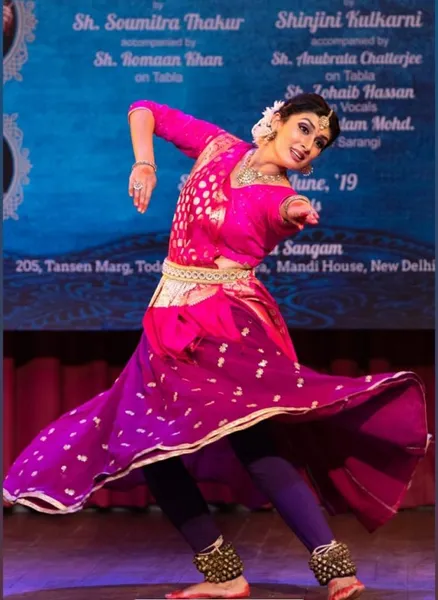
Kathak is one of the eight major forms of Indian classical dance. Its origin is attributed to the traveling bards in ancient northern India known as Kathakaar ("storyteller"), who communicated stories from the Hindu epics through dance, songs, and music. Its name derives from the Sanskrit word kathaa which means "story", and kathakaar which means "the one who tells a story" or "to do with stories". As time went on the dance-form acquired aspects of technical movement expertise in addition to the story-telling features, so nowadays performers usually give equal emphasis to both. Kathak evolved during the Bhakti movement, particularly by incorporating the childhood stories of the Hindu deity Krishna, as well as independently in the courts of North India. Especially during the Mughal rule, the emperors were patrons of Kathak dance and actively promoted it in their royal courts. The Nawab of Awadh, Emperor Wajid Ali Shah himself was a practitioner of Kathak. Kathak performances include Urdu ghazal and commonly used instruments brought during the Mughal period. As a result, it is the only Indian classical dance form to feature Persian elements. Stylistically, the Kathak dance form emphasizes rhythmic foot movements, with the ankles adorned with small bells (Ghungroo) and the movement harmonized to the music and especially its rhythm. The legs and torso are generally straight, and if a story is being told, it is through a developed vocabulary based on the gestures of arms and upper body movement, facial expressions, neck movements, eyes and eyebrow movement, stage movements, bends, and turns. The main focus of the dance becomes the eyes and the foot movements. The eyes work as a medium of communication of the story the dancer is trying to communicate. With the eyebrows the dancer gives various facial expressions. Kathak is mainly found in four styles or schools, called "gharana", named after the cities where the Kathak dance tradition evolved – Jaipur, Banares, and Lucknow and Raigarh. These forms used to be quite distinct in their style and presentation but in recent years have converged to an extent, although they still retain their specialities.
Also on this shelf
Angels and Demons (collection).
Houndstooth.
See also
Uncatalogued shelfText from Wikipedia; plate via Wikimedia Commons. Text CC BY-SA 4.0; plate freely licensed (see Commons). Source record. Images and catalogue data are reproduced from open-access collections.