Textiles and Dress
Immigration to the United States
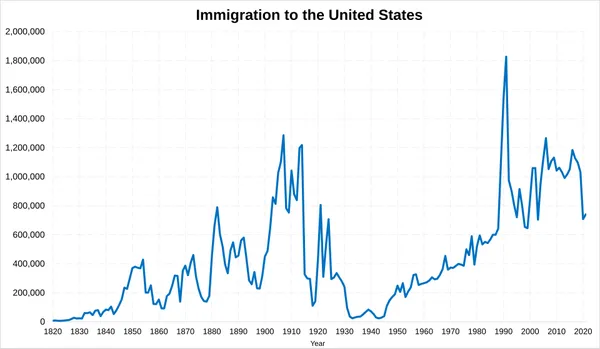
Immigration has been a major source of population growth and cultural change in the United States throughout much of its history. As of January 2025, the United States has the largest immigrant population in the world in absolute terms, with 53.3 million foreign-born residents, representing 15.8% of the total U.S. population—both record highs. While the United States represented about 4% of the total global population in 2024, 17% of all international migrants resided in the United States. In March 2025, the Federation for American Immigration Reform (FAIR) estimated that approximately 18.6 million illegal immigrants resided in the United States. In 2024, immigrants and their U.S.-born children number more than 93 million people, or 28% of the total U.S. population. According to the 2016 Yearbook of Immigration Statistics, the United States admitted a total of 1.18 million legal immigrants (618k new arrivals, 565k status adjustments) in 2016. Of these, 48% were the immediate relatives of United States citizens, 20% were family-sponsored, 13% were refugees or asylum seekers, 12% were employment-based preferences, 4.2% were part of the Diversity Immigrant Visa program, 1.4% were victims of a crime (U1) or their family members were (U2 to U5), and 1.0% who were granted the Special Immigrant Visa (SIV) for Iraqis and Afghans employed by the United States Government. The remaining 0.4% included small numbers from several other categories, including 0.2% who were granted suspension of deportation as an immediate relative of a citizen (Z13); persons admitted under the Nicaraguan and Central American Relief Act; children born after the issuance of a parent's visa; and certain parolees from the former Soviet Union, Cambodia, Laos, and Vietnam who were denied refugee status. Between 1921 and 1965 policies such as the National Origins Formula limited immigration and naturalization opportunities for people from areas outside Northwestern Europe. Exclusion laws enacted as early as the 1880s generally prohibited or severely restricted immigration from Asia, and quota laws enacted in the 1920s curtailed Southern and Eastern European immigration. The civil rights movement led to the replacement of these ethnic quotas with per-country limits for family-sponsored and employment-based preference visas.
Also on this shelf
1650–1700 in Western fashion.
Erika Massaquoi.
See also
Uncatalogued shelfText from Wikipedia; plate via Wikimedia Commons. Text CC BY-SA 4.0; plate freely licensed (see Commons). Source record. Images and catalogue data are reproduced from open-access collections.