Textiles and Dress
Buyao
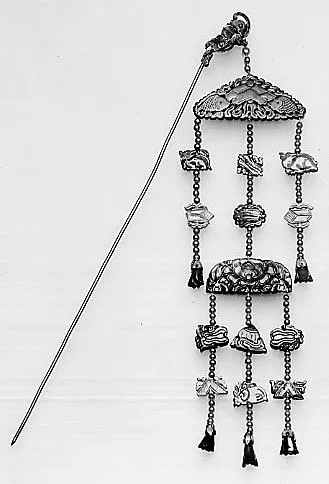
Buyao (simplified Chinese: 步摇; traditional Chinese: 步搖; pinyin: Bùyáo; lit. 'step-shake') is a type of Chinese women's hair ornament. It is a type of Chinese hairpin which was oftentimes decorated with carved designs and jewelries that dangle when the wearer walks, hence the name, which literally means "shake as you go". The buyao is similar to a zan hairpin, except for the presence of its dangling ornaments, which are its primary featured characteristics. The buyao appeared as early as in the Han dynasty, where only noble women in the royal family could wear it. In ancient times, the use of buyao denoted noble status. Some noble women also put buyaos on their tiaras, making their hair decoration more luxurious than simple buyao. Common material used in making the buyao was gold; the ornaments were typically jade and pearls. Other valuable materials could be used, such as silver, agate, etc. Many centuries after the fall of the Han dynasty, the buyao was introduced to ordinary civilians; and when all women were allowed to wear it, more variety of materials were used to produce them. Buyao was passed down over generations; buyao decorated with pendants are still popular in modern-day China.
Also on this shelf
Emma Knuckey.
Dhaka topi.
See also
Uncatalogued shelfText from Wikipedia; plate via Wikimedia Commons. Text CC BY-SA 4.0; plate freely licensed (see Commons). Source record. Images and catalogue data are reproduced from open-access collections.