Textiles and Dress
Gyaru
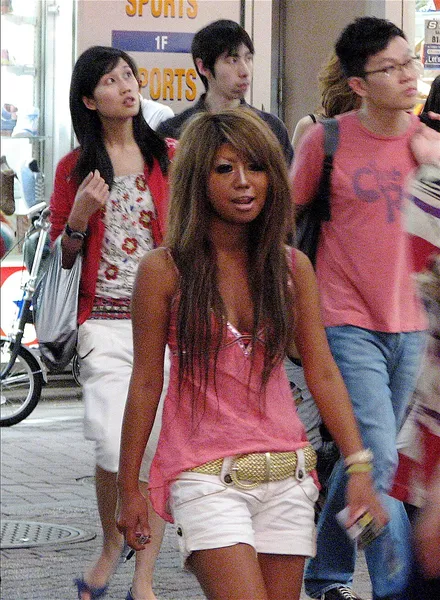
Gyaru (Japanese: ギャル, pronounced [ɡʲaꜜɾɯ]) is a Japanese fashion subculture for all ages, often associated with gaudy fashion styles, an extreme makeup style and dyed hair. The term gyaru is a Japanese transliteration of the English slang word gal. In Japan, it is used to refer to young women who are cheerful, sociable, and adopt trendy fashions, serving as a stereotype of culture as well as fashion. The fashion subculture was considered to be nonconformist and rebelling against Japanese social and aesthetic standards during a time when women were expected to be housewives and to fit the East Asian, or specifically Japanese beauty standards of pale skin and dark hair. Early in its rise, the gyaru subculture was considered racy, and associated with juvenile delinquency and frivolousness among teenage girls. The term is also associated with 1990s and early 2000s dance and clubbing culture in Japan. A popular gyaru subculture specific to the Heisei era (1989–2019) is "kogal (kogyaru) culture" or "kogal fashion,”(子ギャル文化 or コギャル文化) and has been commercialized by Japanese companies such as Sanrio, and even introduced and supported as a Japanese brand by the Japanese government's Ministry of Foreign Affairs, along with “Lolita fashion.” Its popularity peaked in the 1990s and early 2000s during the Heisei era in Japan but is currently having a revival in the last couple of years in Japan during the Reiwa era. There is also a male equivalent of the subculture, known as gyaruo (ギャル男).
Also on this shelf
1400–1500 in European fashion.
Gawai Dayak.
See also
Uncatalogued shelfText from Wikipedia; plate via Wikimedia Commons. Text CC BY-SA 4.0; plate freely licensed (see Commons). Source record. Images and catalogue data are reproduced from open-access collections.