Textiles and Dress
Buddhist mythology
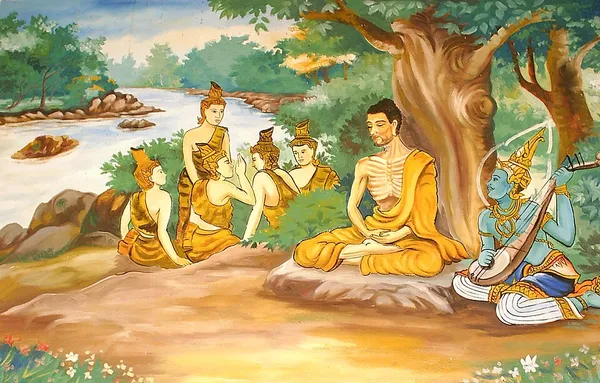
The Buddhist traditions have created and maintained a vast body of mythological literature. The central myth of Buddhism revolves around the purported events of the life of the Buddha. This is told in relatively realistic terms in the earliest texts, and was soon elaborated into a complex literary mythology. The chief motif of this story, and the most distinctive feature of Buddhist myth, is the Buddha's renunciation: leaving his home and family for a spiritual quest. Alongside this central myth, the traditions contain large numbers of smaller stories, which are usually supposed to convey an ethical or Buddhist teaching. These include the popular Jātakas, folk tales or legends believed to be past lives of Gautama Buddha. Since these are regarded as episodes in the life of the Buddha, they are treated here as “myth”, rather than distinguishing between myth, legend, and folk-tale. Buddhist mythology is maintained in texts, but these have always existed alongside oral traditions of storytelling, as well as creative retellings of myths as drama or artworks. This creative mythology continues to this day, and includes film, television, and musical adaptions of Buddhist myths. Myth has always been an important part of the way Buddhists see themselves and form communities. Attitudes to myths vary, with some people seeing the stories as entirely factual, while others see them as symbolic. In this article, as in scholarly study of mythology generally, the use of the term “myth” does not imply a value or truth judgement. Rather, it refers to the study of sacred stories and their meaning within a community. Many scholars have long recognized that Buddhism contains one of the world's great mythologies.
Also on this shelf
Buckram.
Field of the Cloth of Gold.
See also
Uncatalogued shelfText from Wikipedia; plate via Wikimedia Commons. Text CC BY-SA 4.0; plate freely licensed (see Commons). Source record. Images and catalogue data are reproduced from open-access collections.