Textiles and Dress
Chengdu
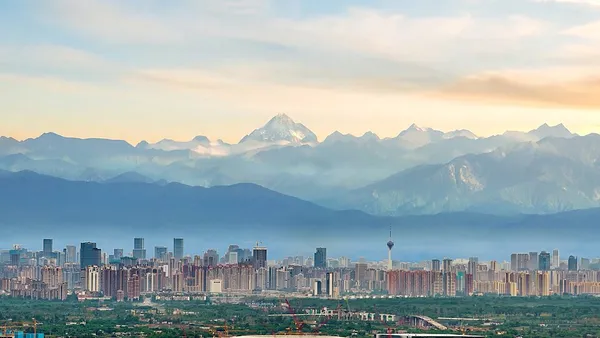
Chengdu is the capital city of the Chinese province of Sichuan. With a population of 20,937,757 at the 2020 census, it is the country's fourth most populous city and the only city with a population of over 20 million apart from provincial-level municipalities. It is traditionally the hub of Western China. Chengdu is in central Sichuan. The surrounding Chengdu Plain is known as the "Country of Heaven" and the "Land of Abundance". Its prehistoric settlers included the Sanxingdui culture. The site of Dujiangyan, an ancient irrigation system, is designated as a World Heritage Site. The Jin River flows through the city. Chengdu's culture reflects that of its province, Sichuan; in 2011, it was recognized by UNESCO as a city of gastronomy. It is associated with the giant panda, a Chinese national symbol that inhabits the area of Sichuan; the city is home to the Chengdu Research Base of Giant Panda Breeding. Founded by the Kingdom of Shu in the 4th century BC, Chengdu is unique as the only Chinese settlement that has maintained its name unchanged throughout the imperial, republican, and communist eras for more than two thousand years. It was the capital of Liu Bei's Shu Han Empire during the Three Kingdoms Era, as well as several other local kingdoms during the Middle Ages. During World War II, refugees from eastern China fleeing from the Japanese settled in Chengdu. After the war, Chengdu was briefly the capital of the Nationalist republican government until it withdrew to Taipei on the island of Taiwan. Under the PRC, Chengdu's importance as a link between Eastern China and Western China expanded, with railways built to Chongqing in 1952, and Kunming and Tibet afterward. In the 1960s, Chengdu became an important defense industry hub. Chengdu is one of the most important economic, financial, commercial, cultural, transportation, research, and communication centers in China. Its economy is diverse, characterized by the machinery, automobile, medical, food, and information technology industries. Chengdu is a leading financial hub, ranking 35th globally on the 2021 Global Financial Centres Index. Chengdu also hosts many international companies; more than 315 Fortune 500 companies have established branches in the city. Chengdu is the third Chinese city with two international airports after Beijing and Shanghai.
Also on this shelf
Culture of Belgium.
Child labour.
See also
Uncatalogued shelfText from Wikipedia; plate via Wikimedia Commons. Text CC BY-SA 4.0; plate freely licensed (see Commons). Source record. Images and catalogue data are reproduced from open-access collections.