Textiles and Dress
1500–1550 in European fashion
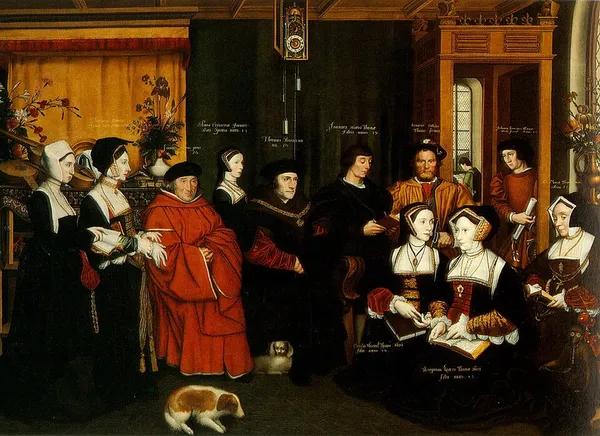
Fashion in the period 1500–1550 in Europe is marked by very thick, big and voluminous clothing worn in an abundance of layers (one reaction to the cooling temperatures of the Little Ice Age, especially in Northern Europe and the British Isles). Contrasting fabrics, slashes, embroidery, applied trims, and other forms of surface ornamentation became prominent. The tall, narrow lines of the Late Middle Ages were replaced with a wide silhouette, conical for women with breadth at the hips and broadly square for men with width at the shoulders. Sleeves were a center of attention, and were puffed, slashed, cuffed, and turned back to reveal contrasting linings. Henry VIII of England (ruled 1509–1547) and Francis I of France (ruled 1515–1547) strove to host the most glittering Renaissance court, culminating in the festivities around the Field of Cloth of Gold (1520). But the rising power was Charles V, king of Spain, Naples, and Sicily from 1516, heir to the style as well as the riches of Burgundy, and Holy Roman Emperor from 1520. The inflow of gold and silver from the New World into recently united Spain changed the dynamics of trade throughout Western Europe, ushering in a period of increased opulence in clothing that was tempered by the Spanish taste for sombre richness of dress that would dominate the second half of the century. This widespread adoption of Hispanic court attire in Europe was seen as a sign of allegiance to the empire of Charles V. Regional variations in fashionable clothing that arose in the 15th century became more pronounced in the sixteenth. In particular, the clothing of the Low Countries, German states, and Scandinavia developed in a different direction than that of England, France, and Italy, although all acknowledged the sobering and formal influence of Spanish dress after the mid-1520s. Linen shirts and chemises or smocks had full sleeves and often full bodies, pleated or gathered closely at neck and wrist. The resulting small frill gradually became a wide ruffle, presaging the ruff of the latter half of the century. These garments were often decorated with embroidery in black or red silk, and occasionally with gold metal threads if the garment was meant to be flashier of ones wealth.
Also on this shelf
Bralessness.
Bereshit (parashah).
See also
Uncatalogued shelfText from Wikipedia; plate via Wikimedia Commons. Text CC BY-SA 4.0; plate freely licensed (see Commons). Source record. Images and catalogue data are reproduced from open-access collections.