Textiles and Dress
1950s in Western fashion
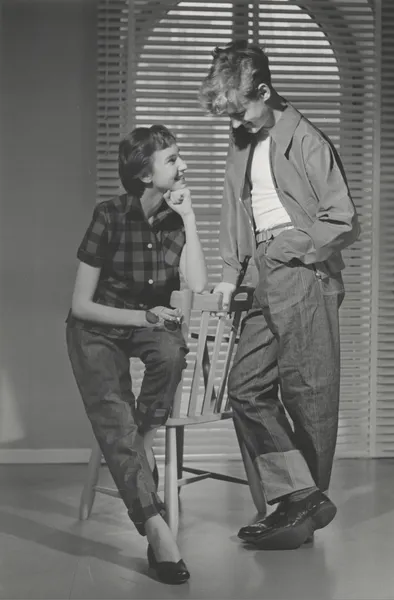
Western fashion in the 1950s was defined by a tension between tradition and transformation. In women's fashion, the hourglass silhouette introduced by Christian Dior's New Look in 1947 dominated the early years of the decade, imposing unprecedented standards of elegance and formality across all social classes, while the latter half saw a gradual loosening of those prescriptions as designers began exploring simpler, less structured alternatives. In men's fashion, the decade witnessed a sharpening divide between established traditions of elegant suiting and the emergence of entirely new modes of dress driven by working-class youth, rock and roll musicians, and Hollywood rebels. The decade has been described as one of "fashion conformity," in which France regained its supremacy as the arbiter of women's dress while the United States, dominant in popular culture, gave rise to a set of countercultural style statements that would shape the fashion of the decades to come. Although Paris maintained its prestige, the couture industry's postwar recovery was a collective triumph: the "elegant triumvirate" of Dior, Jacques Fath, and Pierre Balmain created a benchmark of style imitated throughout the world at all market levels, while designers including Cristóbal Balenciaga, Hubert de Givenchy, and Coco Chanel offered compelling alternatives to the prevailing silhouette. At the same time, Italy emerged as an important new fashion center, especially for sportswear, accessories, and men's tailoring. Fashion historian Daniel Milford-Cottam noted a particularly striking aspect of the decade: "Two ladies could walk down the street in different outfits, yet appear equally modish, be their skirts full and narrow, or one in a form-fitting sheath and the other in a loose sack dress." The decade was marked by rapid technological change in the textile industry, as a succession of new synthetic fibers—including acrylics (1950), polyesters (1953), triacetate (1954), and spandex (1959)—transformed both the production and care of clothing, while permanently stiffened nylon petticoats contributed significantly to the popularity of the full skirts of the period.
Also on this shelf
Havana Plan Piloto.
Daring Tact.
See also
Uncatalogued shelfText from Wikipedia; plate via Wikimedia Commons. Text CC BY-SA 4.0; plate freely licensed (see Commons). Source record. Images and catalogue data are reproduced from open-access collections.