Textiles and Dress
1940s in Western fashion
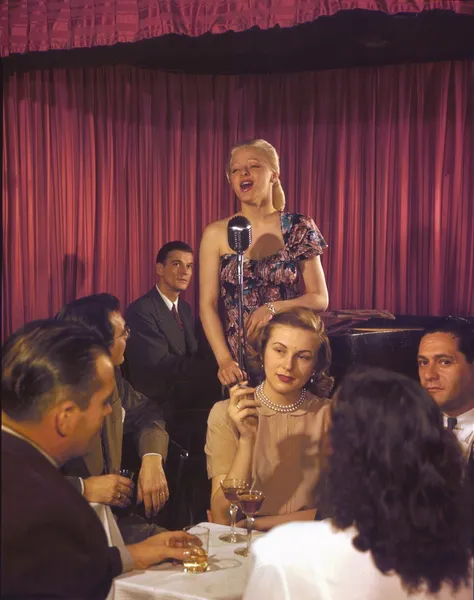
The 1940s in Western fashion were profoundly shaped by World War II (1939–1945), dividing the decade into two distinct phases: a wartime first half defined by scarce resources and minimal change in styles, and a post-war second half marked by a cautious revival, though the war's shadow lingered throughout into the 1950s. Most studies of 1940s fashion have mainly focused on the post-war years, sidelining wartime trends and reducing them to simple, practical designs like slacks, while overlooking diverse national experiences. This reluctance partly arises from viewing fashion as trivial amid the war's immense toll, yet it played a vital role—bolstering economies, aiding the war effort with uniforms, and providing civilians, especially women, a mental escape. Defining "fashion" during this era is complex, as wartime limits—shortages, rationing, and a reduced workforce—stifled rapid style shifts, favoring function over flair. Still, as fashion historians Emmanuelle Dirix and Charlotte Fiell pointed out: "However because the cycle slowed down and changes were often to be found only in the detail rather than the silhouette, doesn't mean that we cannot speak of fashion. Clothing may have become more functional but its decorative qualities were far from lost and even though it became understated and functional, it was still closely linked to the expression of personal and social identity." By 1940, France had already solidified its reputation as the epicenter of women's fashion design. Yet, within the first six months of 1940, German forces seized Paris, initiating an occupation that persisted until late 1944. With many couturiers fleeing and France isolated from the United States and the United Kingdom, French fashion became an internal affair, evolving in stark contrast to global trends. Beyond France, wartime fashion was shaped by rationing, giving rise to utility clothing and uniforms as the prevailing styles. The womenswear aesthetic of this era was understated yet elegant compared to the elaborate glamour of the late 1930s, defined by clean proportions and lines—featuring square, padded shoulders, a belted or tailored waist, and hemlines grazing just below the knee, giving women an overall structured, "mannish" feel.
Also on this shelf
Alexander McQueen.
Gown.
See also
Uncatalogued shelfText from Wikipedia; plate via Wikimedia Commons. Text CC BY-SA 4.0; plate freely licensed (see Commons). Source record. Images and catalogue data are reproduced from open-access collections.