Textiles and Dress
Antwerp Mannerism
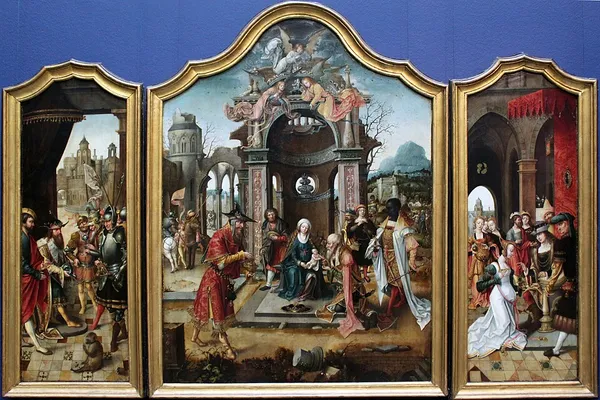
Antwerp Mannerism refers to the style of a group of largely anonymous painters active in the southern Netherlands, principally in Antwerp, in roughly the first three decades of the 16th century. The movement marks the tail end of Early Netherlandish painting and an early phase within Dutch and Flemish Renaissance painting. The style bore no relation to Italian Mannerism, which it mostly predates by a few years, but the name suggests that it was a reaction to the "classic" style of the earlier Flemish painters, just as the Italian Mannerists were reacting to, or trying to go beyond, the classicism of High Renaissance art. The Antwerp Mannerists' style is certainly "mannered", and "characterized by an artificial elegance. Their paintings typically feature elongated figures posed in affected, twisting, postures, colorful ornate costumes, fluttering drapery, Italianate architecture decorated with grotesque ornament, and crowded groups of figures...". Joseph Koerner notes "a diffuse sense of outlandishness in Antwerp art, of an exoticism both of subject and means ... evoking a non-localized elsewhere". The subject of the Adoration of the Magi was a particular favourite, as it allowed the artists to give free rein to their preoccupation with ornament and the simulation and imitation of luxury products. The Biblical Magi were also regarded as the patron saints of travellers and merchants, which was relevant for the painters' clientele in what had become Europe's main centre for international trade, in a "meteoric rise" after 1501, when the first Asian cargos were landed by Portuguese ships. The theme of rich commodities arriving from distant and exotic parts of the world had a natural appeal to Antwerp merchant buyers, a large proportion themselves foreign. Many artists from around the Netherlands and further afield moved to the city to benefit from the boom, which saw large workshops "that grew into assembly lines", and a great increase in the quantity of art produced, but also some fall in quality; this is especially seen among the minor figures grouped under this term. Many smaller works were produced without commissions, for sale from shop windows, at fairs, or to dealers, rather than for an individual commission, an indication of a growing trend in Netherlandish painting.
Also on this shelf
Drag Race Philippines.
Bianfu.
See also
Uncatalogued shelfText from Wikipedia; plate via Wikimedia Commons. Text CC BY-SA 4.0; plate freely licensed (see Commons). Source record. Images and catalogue data are reproduced from open-access collections.