Textiles and Dress
Flag of Australia
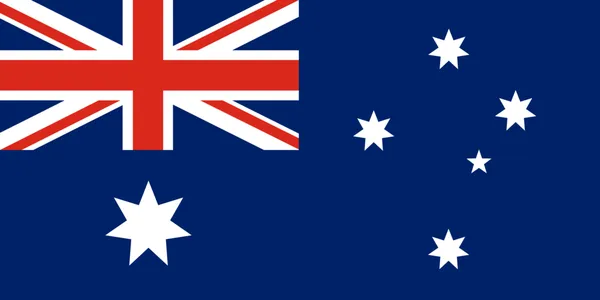
The national flag of Australia is based on the British Blue Ensign—a blue field with the Union Jack in the upper hoist quarter—featuring a large white seven-pointed star (the Commonwealth Star) and a representation of the Southern Cross constellation, made up of five white stars (one small five-pointed star and four larger seven-pointed stars). The original version of the flag first flew as the Commonwealth blue ensign on 3 September 1901, after being selected alongside a merchant naval red ensign in a competition held following federation. A slightly simplified version as approved by King Edward VII was officially adopted in 1903. It was later modified to the current design on 8 December 1908, with the change from a six to a seven-point Commonwealth Star. Initially restricted to government and shipping use, the blue ensign slowly gained prominence as a popular Australian symbol alongside the red ensign, which had less restrictions on its use. At first, the flag remained officially subordinate to the Union Jack, and solely flying the blue ensign could be seen as expressing disloyalty to the British Empire. By 1954, however, in line with Australia's increasing independence from the United Kingdom, the blue ensign was designated as the Australian National Flag with the passage of the Flags Act 1953. The act also gave the Australian flag precedence over the Union Jack for the first time. Over time, usage of the Union Jack decreased, with most Australians considering the blue ensign the national flag by the 1970s. Australia also has a number of other official flags representing its states and territories, indigenous peoples and government bodies.
Also on this shelf
J. Press.
Angels and Demons (collection).
See also
Uncatalogued shelfText from Wikipedia; plate via Wikimedia Commons. Text CC BY-SA 4.0; plate freely licensed (see Commons). Source record. Images and catalogue data are reproduced from open-access collections.