Textiles and Dress
Carnival of São Paulo
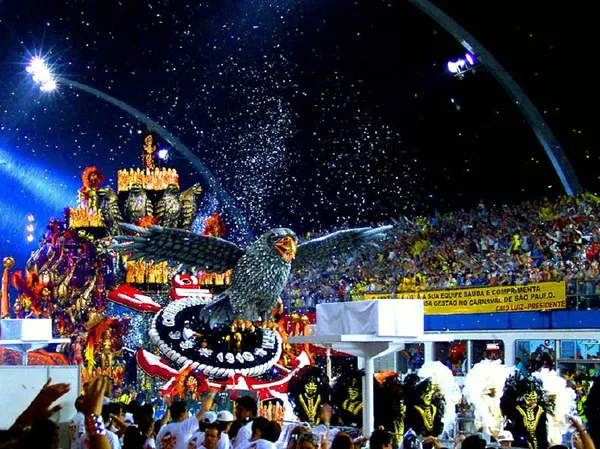
The Carnival of São Paulo (Portuguese: Carnaval de São Paulo) is a major Brazilian Carnival. It features a parade of samba schools and takes place in the Anhembi Sambadrome of São Paulo on the Friday and Saturday night of the week of Carnival. It is currently considered one of Brazil's biggest and most important popular events and is recognized as Cultural Heritage of Brazil and Intangible Heritage of the state by the Council for the Defense of Historical, Archaeological, Artistic and Tourist Heritage (CONDEPHAAT). Carnival celebrations and the samba itself in São Paulo are slightly different from the Carnival in the city of Rio de Janeiro, though there is a clear difference in the rhythm of the sound – in other words, the speed and tempo of the music. Samba artists from São Paulo were accustomed to difficult lives on the coffee plantations and migrated to the city in search of labour work. The São Paulo author and journalist Plínio Marcos called São Paulo's samba "the samba of work, hardship, drawn to the drumming", which contrasted greatly with the lyricism and cadence of carioca samba from Rio de Janeiro. In addition, São Paulo samba was decisively influenced by other strongly percussive rhythms, such as jongo-macumba, also known as Caxambú. From that time dates the beginning of the relationship between Carnival and the law: the police repression suffered by samba performers, carried out harshly and without criteria. Samba performers, not only during Carnival but throughout the year, were seen as marginal figures and were harshly persecuted by the authorities. On the marginalized outskirts of a São Paulo under construction, the sound of percussion announced an immigrant culture that would later influence Brazilian culture in a definitive way.
Also on this shelf
Chileans.
Colony Arcade Building.
See also
Uncatalogued shelfText from Wikipedia; plate via Wikimedia Commons. Text CC BY-SA 4.0; plate freely licensed (see Commons). Source record. Images and catalogue data are reproduced from open-access collections.