Textiles and Dress
1930s in Western fashion
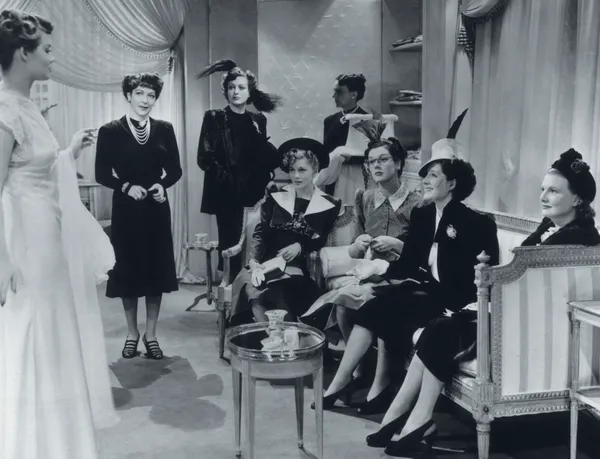
Western fashion in the 1930s was characterized—in womenswear—by a departure from the boxy, boyish look from the previous decade in favor of a more mature and feminine silhouette, with the return of natural waistlines and a heightened emphasis on glamour, elegance and sophistication. The era is well framed by two major world events: the 1929 Wall Street Crash, with the ensuing Great Depression that lasted until the end of the decade; and the onset of World War II in 1939. Since they are situated between the "roaring" era of the 1920s and the period of war-induced austerity of the 1940s, the 1930s are often overlooked in fashion history discussions and reduced to a mere transitional era. Nevertheless, the 1930s saw many changes and innovations in fashion design, technology and consumer culture, and has been referred to as the "Design Decade" both contemporaneously and in modern times. The period was also one of expansion and consolidation of the Hollywood film industry and its star system, which became a key actor in the setting and dissemination of fashion trends, a role hitherto dominated by the haute couture centered in Paris. Although the 1930s were considered a period of great modernity in clothing, the new styles were defined by a reinterpretation of the past. At the beginning of the decade, the neoclassical style—so called because of its ancient Greek influence—emerged and defined the look of the period, which highlighted the natural female figure through the innovation of the bias cut. Pioneered by couturier Madeleine Vionnet, the technique consisted of cutting the fabrics at an angle instead of in a straight line, which made them drape smoothly over the woman's figure. This meant that for the first time in the history of Western fashion, dresses skimmed to the body without any sculpting underlayer. Other styles that characterized the decade were romanticism, which recovered elements of Victorian fashion; and surrealism, epitomized in the work of designer Elsa Schiaparelli. Some of the leading fashion designers of the 1930s include the French-based Vionnet, Schiaparelli, Madame Grès, Jeanne Lanvin, Edward Molyneux, Jean Patou and Robert Piguet; the British Norman Hartnell and Victor Stiebel; and the Americans Hattie Carnegie, Jessie Franklin Turner, Nettie Rosenstein, Valentina, Sally Milgrim and Elizabeth Hawes, among others.
Also on this shelf
Chaga people.
Dupatta.
See also
- ▸History of the cotton industry in Catalonia
- ▸1973 Chilean coup d'état
- ▸Handcrafts and folk art in Tlaxcala
Text from Wikipedia; plate via Wikimedia Commons. Text CC BY-SA 4.0; plate freely licensed (see Commons). Source record. Images and catalogue data are reproduced from open-access collections.