Textiles and Dress
Bharatanatyam
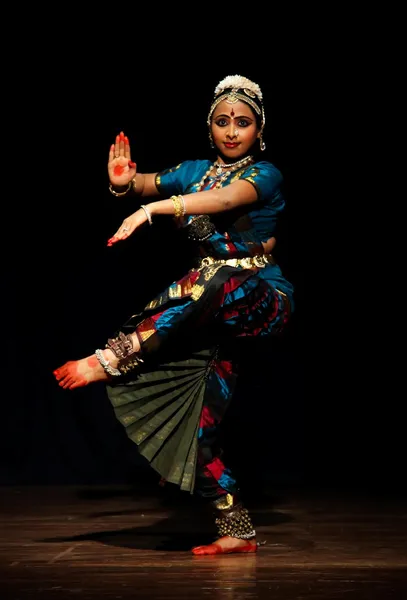
Bharatanatyam is an Indian classical dance form that comes from Tamil Nadu, India. It is a classical dance form recognized by the Sangeet Natak Akademi, and expresses South Indian religious themes and spiritual ideas, particularly of Shaivism and in general of Hinduism. A description of the precursors of Bharatanatyam from the Natya Shastra dates from around 500 BCE to 500 CE, while those in the ancient Tamil epic Silappatikaram date to around 171 CE. Temple sculptures of the 6th to 9th centuries CE suggest dance was a refined performance art by the mid-1st millennium CE. Sadiraattam, which was renamed Bharatanatyam in 1932, is the oldest classical dance tradition in India. Bharatanatyam contains different types of bani. Bani, or "tradition", is a term used to describe the dance technique and style specific to a guru or school, often named after the village of the guru. The Bharatanatyam style is noted for its fixed upper torso, bent legs, and flexed knees (aramandi) combined with footwork, and a vocabulary of sign language based on gestures of hands, eyes, and facial muscles. The dance is accompanied by music and a singer, and typically the dancer's guru is present as the nattuvanar, or director-conductor of the performance and art. The performance repertoire of Bharatanatyam, like that of other classical dances, includes nrita (pure dance), nritya (conveys a meaning to the audience through hand gestures) and natya (consists of the elements of drama). A program of Bharatanatyam usually lasts two hours without interruption and includes a specific list of procedures, all performed by one dancer, who does not leave the stage or change costumes. The accompanying orchestra—composed of drums, drone, and a singer—occupies the back of the stage, led by the guru, or teacher, of the dancer. Sadiraattam remained exclusive to Tamil Hindu temples through the 19th century. It was banned by the colonial British government in 1910, but the Indian community protested against the ban and expanded its performance outside temples in the 20th century as Bharatanatyam. Modern stage productions of Bharatanatyam have become popular throughout India and include performances that are purely dance-based, featuring non-religious ideas and fusion themes. The Thanjavur Quartet developed the basic structure of modern Bharatanatyam by formalizing it.
Also on this shelf
Croatian national costume.
Celine (brand).
See also
Uncatalogued shelfText from Wikipedia; plate via Wikimedia Commons. Text CC BY-SA 4.0; plate freely licensed (see Commons). Source record. Images and catalogue data are reproduced from open-access collections.