Textiles and Dress
Headscarf controversy in Turkey
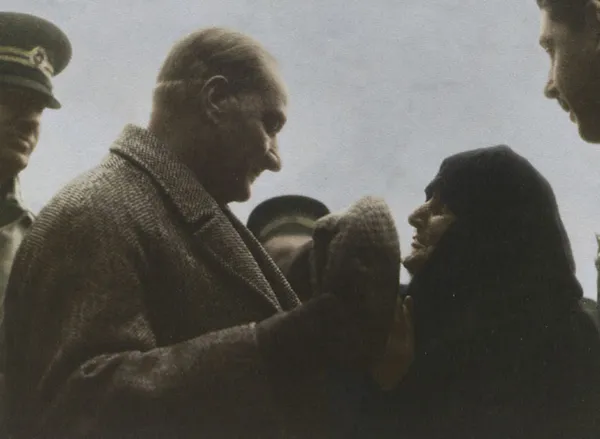
In the Ottoman Empire, dress codes were based on religious and ethnic principles and also served as an indicator of professional and social status. However, in the last two centuries of the Empire, with increasing interaction with the Western world, Muslim women began to abandon traditional clothings and wear garments that bore Western influences. These garments left their faces and necks exposed as outer dress. During this period, imperial decrees were issued to prevent this trend. However, the presence of some rulers and sultans, alongside the writers and artists who encouraged this change, accelerated this trend rather than halting it. Mustafa Kemal Atatürk had the ambition to transform Turkey into a new modern secular state. The modernization reform program of Turkey by him abolished sex segregation and encouraged women to unveil as a part of a social revolution in order to make Turkey a modern state. He appeared in public with his wife Latife Uşaki unveiled, and arranged formal state receptions with dinner and dance where men and women could mingle, to encourage women to leave seclusion and adopt modern clothing, and in the mid-1920s, upper and middle class Turkish women started to appear unveiled in public. In 1925, the Turkish government introduced a new Family Law modelled after the Swiss Family Law, and in the same year, it banned the fez, a cultural implement introduced and encouraged by Mahmud II as a symbol of modernity and Westernization. In 1928, the Turkish government removed the official religion provision from the constitution. Even so, Atatürk never forbade the headscarf (the dominant form of hijab in Turkey, where it is called başörtüsü meaning head cover), but did not encourage its use either. One exception to this might be the 1935 Ministry of Interior circular banning women from wearing clothing that covered their faces. While no law was passed, the ban was enforced through municipalities and law enforcement. However, this ban during the single-party era was not the first; similar practices existed in the Ottoman Empire, such as during the reign of Abdul Hamid II. Between 92 and 95% of Turkey is Muslim, According to some studies the use of veil is 48 to 54% of women in general, while only 48% of the young women are veiling.
Also on this shelf
Culture of the United Kingdom.
Culture of Brittany.
See also
Uncatalogued shelfText from Wikipedia; plate via Wikimedia Commons. Text CC BY-SA 4.0; plate freely licensed (see Commons). Source record. Images and catalogue data are reproduced from open-access collections.