Textiles and Dress
Ghoonghat
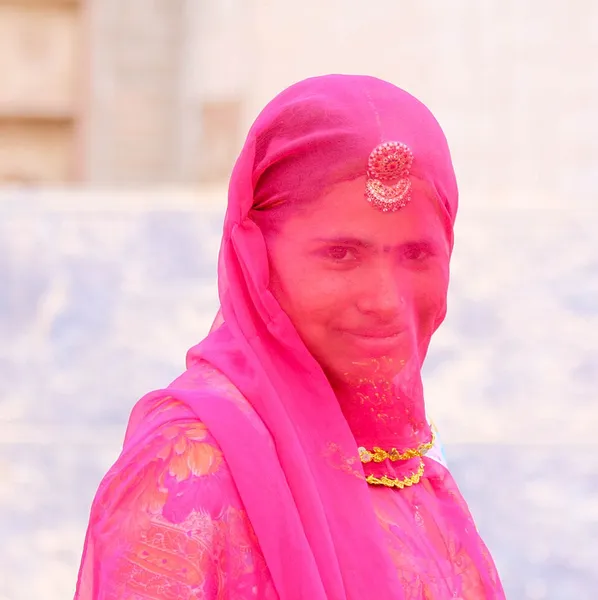
A ghoonghat (ghunghat, ghunghta, ghomta, orhni, odani, laaj, chunari, jhund, kundh) is a head covering or headscarf, worn primarily in the Indian subcontinent by some married Hindu and Jain women to cover their heads, and often their faces as well. Generally aanchal or pallu, the loose end of a sari is pulled over the head and face in order to act as a ghoonghat. A dupatta (long scarf) is also commonly used as a ghoonghat. Since the ancient period of India, certain veiling practices (what became known as ghoonghat) has been partially practiced among a section of women. However, it is notable that some section of society from the 1st century B.C. advocated the use of the veil for married women. There is no proof that a large section of society observed strict veiling until the medieval period. Today, facial veiling by Hindu women as part of everyday attire is now mostly limited to the Hindi Belt region of India, particularly in Haryana, Rajasthan, western Uttar Pradesh and some parts of Sindh and northern Gujarat. It has been both romanticized and criticized in religious and folk literature.
Also on this shelf
1100–1200 in European fashion.
Ahmad Tajuddin.
See also
Uncatalogued shelfText from Wikipedia; plate via Wikimedia Commons. Text CC BY-SA 4.0; plate freely licensed (see Commons). Source record. Images and catalogue data are reproduced from open-access collections.