Textiles and Dress
Dravidian peoples
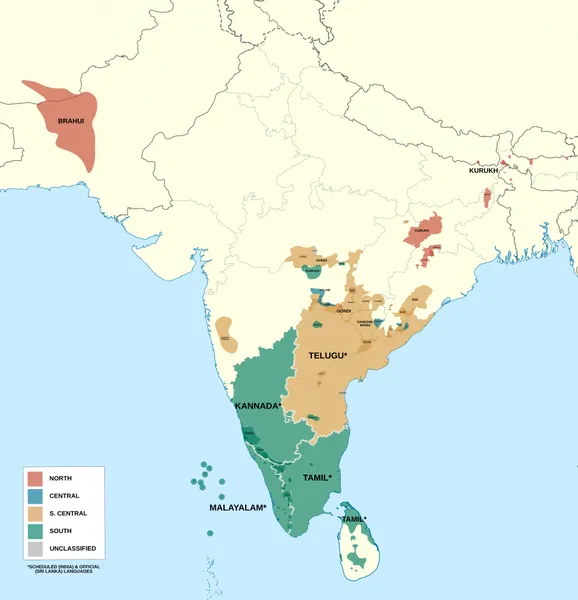
The Dravidian peoples, Dravidian-speakers or Dravidians, are a collection of ethnolinguistic groups native to South Asia who speak Dravidian languages. There are around 250 million native speakers of Dravidian languages. The two largest Dravidian groups are the Telugus (c. 95M) and Tamils (c. 85M). The next three largest are the Kannadigas (c. 44M), Malayalis (c. 40M), and Gondis (c. 13M). India's 22 scheduled languages include these four Dravidian languages: Telugu, Tamil, Kannada, and Malayalam. Dravidian speakers form the majority of the population of South India and are native to India, Pakistan, Afghanistan, Bangladesh, the Maldives, Nepal, Bhutan and Sri Lanka. Dravidian peoples are also present in Singapore, Mauritius, Malaysia, France, South Africa, Myanmar, East Africa, the Caribbean, and the United Arab Emirates through migration. Proto-Dravidian may have been spoken in the Indus civilization, suggesting a "tentative date of Proto-Dravidian around the early part of the third millennium BCE", after which it branched into various Dravidian languages. South Dravidian I (including pre-Tamil) and South Dravidian II (including pre-Telugu) split around the eleventh century BCE, with the other major branches splitting off at around the same time. The origins of the Dravidians are a "very complex subject of research and debate". They are regarded as indigenous to the Indian subcontinent, but may have deeper pre-Neolithic roots from Western Asia, specifically from the Iranian plateau. Their origins are often viewed as being connected with the Indus Valley Civilisation, hence people and language spread east and southwards after the demise of the Indus Valley Civilisation in the early second millennium BCE, some propose not long before the arrival of Indo-Aryan speakers, with whom they intensively interacted. Some scholars have argued that the Dravidian languages may have been brought to India by migrations from the Iranian plateau in the fourth or third millennium BCE or even earlier. However, reconstructed proto-Dravidian vocabulary suggests that the family is indigenous to India. Genetically, the ancient Indus Valley people were composed of a primarily Iranian hunter-gatherers (or farmers) ancestry, with varying degrees of ancestry from local hunter-gatherer groups.
Also on this shelf
Head covering for Jewish women.
Exekias.
See also
Uncatalogued shelfText from Wikipedia; plate via Wikimedia Commons. Text CC BY-SA 4.0; plate freely licensed (see Commons). Source record. Images and catalogue data are reproduced from open-access collections.