Textiles and Dress
Idia
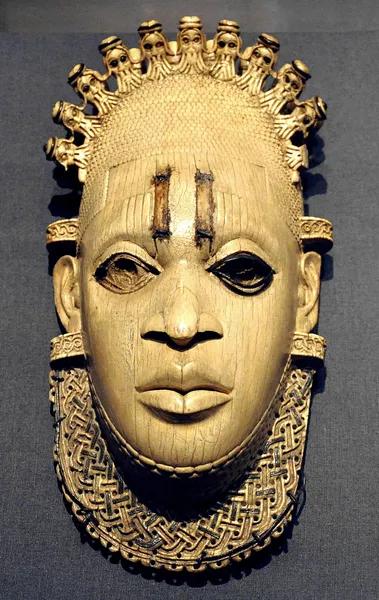
Idia was a royal woman of the Kingdom of Benin and the first person to hold the title of Iyoba, an Edo term for the mother of the reigning Oba ('king'). A wife of Oba Ozolua and the mother of Oba Esigie, she held ritual, military and political authority during the succession disputes and conflicts associated with her son's accession and the early decades of his reign in the first half of the sixteenth century. Neither her birth nor her death can be dated precisely, although she is generally placed in the late fifteenth and early sixteenth centuries and is traditionally said to have originated from Ugieghudu in the Isi district of the kingdom. Edo accounts attribute Esigie's success against his half-brother Aruanran partly to Idia's political counsel, military forces, ritual protection and knowledge of medicine. An Edo proverb describes her as the only woman who went to war, but surviving traditions differ as to whether she personally led troops, accompanied Esigie on campaign or dispatched soldiers from her court at Uselu. Her contingent participated in the Igala–Benin War of 1515–1516, and her head slave and his men were credited with killing the commander of the Igala forces. Esigie established the office of Iyoba for Idia, gave her a separate palace in Lower Uselu and assigned her chiefs, servants, lands, privileges and a court comparable to those of Benin's senior officeholders. The title subsequently became a permanent institution within Benin's ritual and political structure, and later Obas formally installed their mothers as Iyoba after taking the throne. Tradition also attributes to Idia the introduction of the Ekasa ritual dance and the curved coral-beaded ukpe-okhue ('parrot's beak') headdress, both of which became associated with the office and its ceremonies. After her death, Idia became a recurring subject in Benin court art, appearing on cast-metal memorial heads, carved ivory pendants, altar tusks, bells and other royal objects. Later, an ivory pendant identified with her served as the emblem of the 1977 Second World Black and African Festival of Arts and Culture, commonly known as FESTAC 77, and was subsequently reproduced as a symbol of Nigerian and African cultural heritage.
Also on this shelf
Batik.
Honan Chapel.
See also
Uncatalogued shelfText from Wikipedia; plate via Wikimedia Commons. Text CC BY-SA 4.0; plate freely licensed (see Commons). Source record. Images and catalogue data are reproduced from open-access collections.