Textiles and Dress
Japanese clothing during the Meiji period
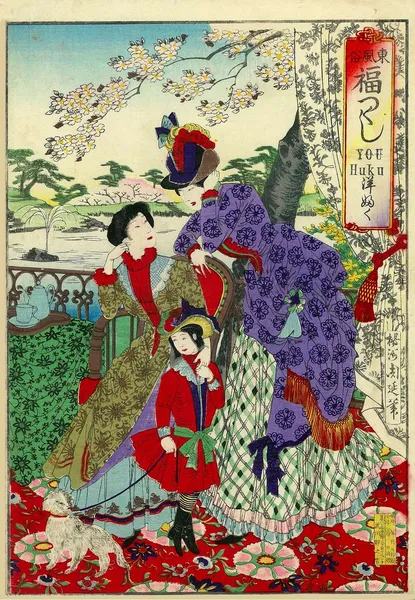
Japanese clothing during the Meiji period (1867–1912) saw a marked change from the preceding Edo period (1603–1867), following the final years of the Tokugawa shogunate between 1853 and 1867, the Convention of Kanagawa in 1854 – which, led by Matthew C. Perry, forcibly opened Japanese ports to American vessels, thus ending Japan's centuries-long policy of isolation – and the Meiji Restoration in 1868, which saw the feudal shogunate dismantled in favour of a Western-style modern empire. During the Meiji period, Western-style fashion (yōfuku) was first adopted most widely by Japanese men in uniformed, governmental or otherwise official roles, as part of a drive towards industrialisation and a perception of modernity. Western-style uniform was first introduced as a part of government uniform in 1872, and quickly became associated with elitism, modernity, and money. The Western trends adopted by the government were not popular with the public at large. While those in employed in the Imperial court, office workers and factory workers wore Western dress at work, many still chose to wear kimono and other traditional Japanese clothing (wafuku) at home. The transition to Western-style clothing throughout wider Japanese society happened gradually, with a significant degree of resistance. This transition came to be referred to as three, distinctive periods: Bunmei kaika (1868–1883), the Rokumeikan (1883–1890s), and an unnamed period of nativist revival afterwards in the 1890s. The Bunmei kaika period was a period wherein Western products were adopted quickly, and were mixed with elements of yōfuku, such as Western-style shoes and hats being worn by men when wearing kimono. During the Rokumeikan period, Western culture grew in popularity, and a number of clothing reforms including a Westernised system of dress. Two decades into the Meiji period, it became increasingly hard to find men with uncropped, chonmage-style hair and women with blackened teeth, styles mostly relegated to rural areas. Following the Rokumeikan period, due to a proliferation of Western dress over two decades, a single piece of yōfuku no longer served the purpose of distinguishing someone as modern and progressive.
Also on this shelf
Croatian national costume.
Bead embroidery.
See also
Uncatalogued shelfText from Wikipedia; plate via Wikimedia Commons. Text CC BY-SA 4.0; plate freely licensed (see Commons). Source record. Images and catalogue data are reproduced from open-access collections.