Textiles and Dress
Banjar people
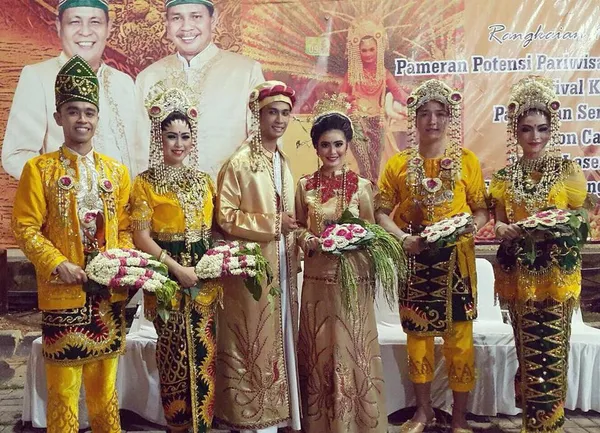
The Banjarese (Banjar: Urang Banjar, Jawi script: اورڠ بنجر; Indonesian: Orang Banjar) or simply Banjar, are an Austronesian ethnic group native to the Banjar regions (notably Banjarmasin, Banjarbaru, Banjar Regency, etc.) in the southeastern Kalimantan regions of Indonesia. Nowadays, Banjarese diaspora can be found in neighbouring Banjar regions as well; including Kotabaru Regency, the southeastern regions of Central Kalimantan, southernmost regions of East Kalimantan, and some provinces of Indonesia in general. The Banjarese diaspora community also can be found in neighbouring countries of Indonesia, such as Brunei, Malaysia (notably in Perak, Selangor, Kedah, and Johor, with significant minorities in Sabah), and Singapore. The Banjars form the major indigenous group within the southern coast of the South Kalimantan region, which is rich in history, traditional heritage, and various attire and language as well as customs. Beginning from their earliest Animist-Buddhist-Hindu kingdoms of Negara Dipa and Negara Daha, followed by the establishment of the Sultanate of Banjar in the 16th century after the massive Islamisation and subsequent interactions with the Europeans through both the British and the Dutch following the arrivals of the English East India Company (EIC) and the Dutch East India Company (VOC) in 1602 and 1603, which resulted in their rapid subsequent modernisation in the late 19th century through transition from a river-based agrarian society to a more integrated, urbanised, and administratively diverse community after the abolition of their sultanate by the Dutch in 1860. They are further divided into three distinct sub-ethnics known as the Batang Banyu Banjar, Kuala Banjar, and Pahuluan Banjar and are acknowledged to be heavily influenced by both Malay and Dayak languages through phonological and morphological perspectives, with Banjar within the region of South Kalimantan classified into two main linguistic types: the Hulu Banjar and Kuala Banjar.
Also on this shelf
1940s in Western fashion.
Al-Azhar attire.
See also
Uncatalogued shelfText from Wikipedia; plate via Wikimedia Commons. Text CC BY-SA 4.0; plate freely licensed (see Commons). Source record. Images and catalogue data are reproduced from open-access collections.