Textiles and Dress
Hangaroc
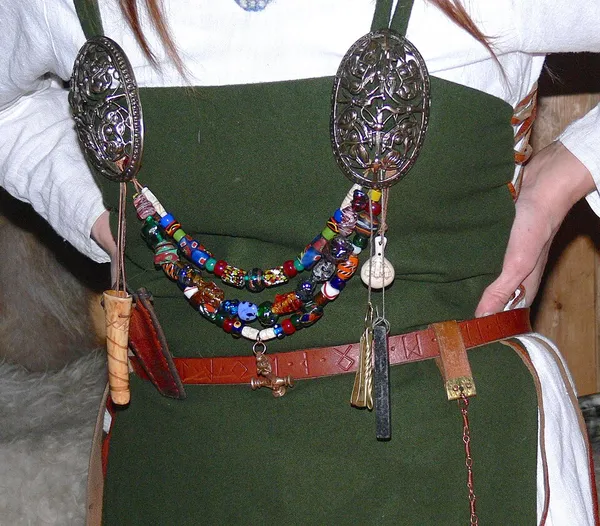
A hangaroc (sometimes spelled hangerock or hangerok) was an apron-like outer garment worn by women of Norse origins and some other northern European cultures in the 8th, 9th and 10th centuries. In its usual form the hangaroc comprised a woollen or linen tailored tube wrapped around the body under the armpits and suspended by a pair of cloth straps that ran over the shoulders, secured by brooches. It hung down to mid-calf. The garment was shaped somewhat like a pinafore, and would usually be worn over a tunic-dress called a særk or a kirtle (underdress). Hangarocs were usually secured by a pair of oval brooches, called "tortoise brooches", which are diagnostic of women's graves from the period. Wealthier women would wear their hangaroc decorated with braided wool or embroidery.
Also on this shelf
Fashion in the Liao dynasty.
Chokha.
See also
Uncatalogued shelfText from Wikipedia; plate via Wikimedia Commons. Text CC BY-SA 4.0; plate freely licensed (see Commons). Source record. Images and catalogue data are reproduced from open-access collections.