Textiles and Dress
Benkan
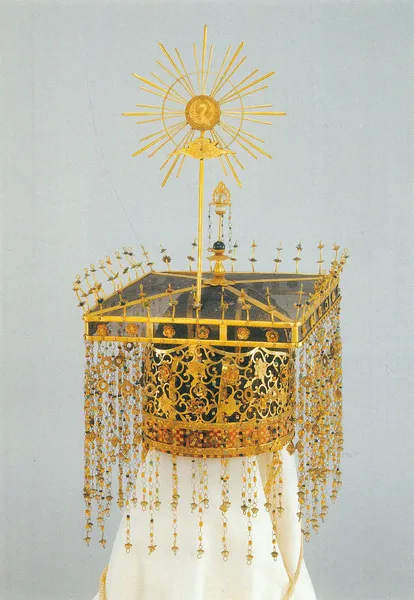
The benkan (冕冠; lit. 'crown') is a type of ceremonial crown formerly worn by Japanese emperors and crown princes. It is also called tama no kōburi (玉乃冠; lit. 'jeweled crown'). Although gilt-bronze crowns and crown caps are known from elite burials of the Kofun period, the benkan proper is first clearly associated with the imperial court in the early 8th century. The Shoku Nihongi records that Emperor Shōmu wore the benpuku (冕服; ceremonial crown and robes) for the first time at the New Year's court ceremony of 732. Later Japanese benkan combined features of the Chinese mianguan, such as a crown board and pendant jeweled ornaments, with distinctive Japanese elements, most notably a sun-shaped ornament on the top of the crown. The benkan was worn together with the imperial ceremonial robe called kon'e at enthronement and chōga (朝賀, New Year's court audience) ceremonies. Its last use was at the enthronement ceremony of Emperor Kōmei in 1847, and it has not been worn since. Related imperial crowns included the hōkan (宝冠; lit. 'precious crown') for a female emperor and the nikkeikan (日形冠; lit. 'sun-shaped crown') for a child emperor. Edo-period examples of the benkan, hōkan, and nikkeikan survive as imperial treasures (御物) and are not ordinarily open to public view. They have, however, occasionally been displayed in exhibitions commemorating imperial enthronements.
Also on this shelf
Begusarai.
Culture of Kerala.
See also
Uncatalogued shelfText from Wikipedia; plate via Wikimedia Commons. Text CC BY-SA 4.0; plate freely licensed (see Commons). Source record. Images and catalogue data are reproduced from open-access collections.