Textiles and Dress
Escoffion
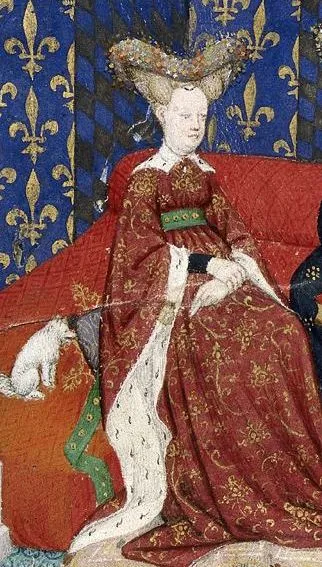
An escoffion ([ɛsˈkɔfiˌjã]) is a piece of female medieval headwear which was popular during the Late Middle Ages (1250–1500). It originated and was popular in European countries such as England, France and Germany, and several Balkan states. The headpiece was made out of a thick, circular roll of material like wool, felt or silk. The material was shaped, by sewing or starching, into a double-horned configuration, with each horn sometimes being up to a yard long. Over the headdress, gauze or silk was sometimes draped for weight distribution or aesthetic purposes. The escoffion style was a sub-branch of a popular style of headwear called hennin. The style of the escoffion developed over time, eventually given its own name because of its popularity and distinct features which differed from the original conical hennin. The escoffion was a type of "reticulated headdress", meaning that it was bound together by a network of golden thread or wire. The headdress itself was made out of various types of materials, predominantly wool, using looms. The more intricate details were sewn on by skilled craftswomen or men. The hair of the wearer was tucked away under the headdress in a number of ways; the hair could either be braided and tucked underneath the escoffion or pinned into place on each side of the head in configurations sometimes known as "side-pillars". Alternatively, the headdress was worn over a wimple or caul, simple pieces of cloth which kept the wearer's hair out of sight and provided a base for the larger headdress to attach on to. The covering of hair, sometimes called a bongrace, was a common custom amongst women of the Middle Ages, and continued to be a prominent feature in headwear for many centuries. The escoffion was usually worn by women of high status, such as those who lived in the court, or those who were a part of the Royal Family. Who exactly could wear headwear such as the escoffion, or other luxury clothing items, was dictated by sumptuary laws which controlled the over-expenditure on luxury items and also maintained a type of social hierarchy based on birth, influence or economic income. While the escoffion was deemed a luxury item for a time, it was later deemed as ungraceful or clunky, as well as being condemned by moralist or religious groups for supposedly depicting satanic imagery.
Also on this shelf
Barong tagalog.
Dunkin' Donuts.
See also
Uncatalogued shelfText from Wikipedia; plate via Wikimedia Commons. Text CC BY-SA 4.0; plate freely licensed (see Commons). Source record. Images and catalogue data are reproduced from open-access collections.