Textiles and Dress
Battle of Plataea
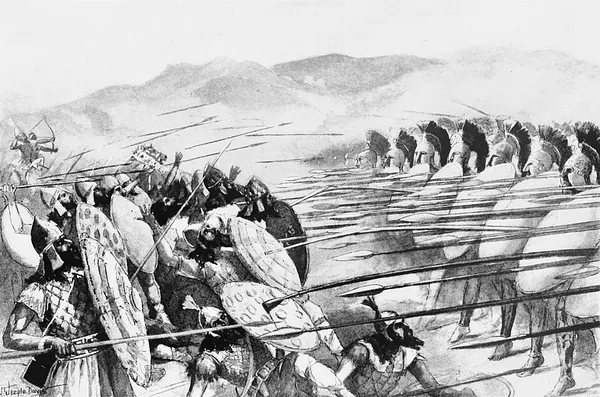
The Battle of Plataea was the final land battle during the second Persian invasion of Greece. It took place in August 479 BC near the city of Plataea in Boeotia, and was fought between an Achaemenid army led by Mardonius (allied with Boeotia, Thessaly, and Macedon) and the Spartan-led Hellenic alliance including Athens, Corinth, Tegea, Megara and other city-states. At the preceding Battle of Salamis, the allied Greek navy had won an unlikely but decisive victory, preventing the conquest of the Peloponnese region. Xerxes then retreated with much of his army, leaving his general Mardonius to finish off the Greeks the following year. In the summer of 479 BC, the Greeks assembled a huge army and marched out of the Peloponnese. The Persians retreated to Boeotia and built a fortified camp near Plataea. The Greeks, however, refused to be drawn into the prime terrain for cavalry around the Persian camp, resulting in a stalemate that lasted eleven days. While attempting a retreat after their supply lines were disrupted, the Greek battle line fragmented. Thinking that the Greeks were in full retreat, Mardonius ordered his forces to pursue them, but the Greeks, particularly the Spartans, Tegeans and Athenians halted and gave battle, routing the lightly armed Persian infantry and killing Mardonius. A large portion of the Persian army was trapped in its camp and killed. The destruction of this army, and the remnants of the Persian navy allegedly on the same day at the Battle of Mycale, decisively ended the invasion.
Also on this shelf
Headscarf.
History of the Jews in the United States.
See also
Uncatalogued shelfText from Wikipedia; plate via Wikimedia Commons. Text CC BY-SA 4.0; plate freely licensed (see Commons). Source record. Images and catalogue data are reproduced from open-access collections.