Textiles and Dress
Islamic veiling practices by country
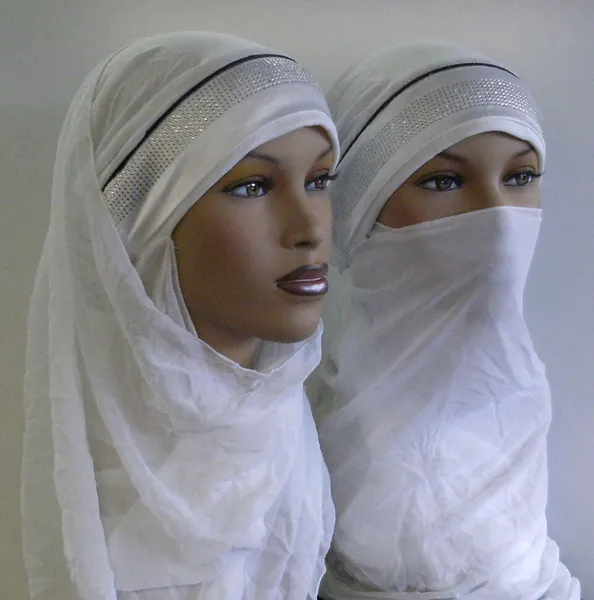
Various styles of head coverings, most notably the khimar, hijab, chador, niqab, paranja, yashmak, tudong, shayla, safseri, çarşaf, haik, dupatta, boshiya and burqa, are worn by Muslim women around the world, where the practice varies from mandatory to optional or restricted in different majority Muslim and non-Muslim countries. Wearing the hijab is mandatory in Islamic Republic of Iran and the Taliban-led Islamic Emirate of Afghanistan. Gaza school officials have also voted to require young girls to wear hijab, though the Palestinian Authority (in 1990) considered the hijab optional. The hijab is traditionally associated with Islamic principles of modesty, privacy, and spiritual awareness. In addition to its religious significance, it has also become a marker of cultural identity and, in some contexts, a form of personal or fashion expression. Surah An-Nur (24:31) in the Qur'an states: "And tell the believing women to lower their gaze and guard their private parts and not expose their adornment except that which [necessarily] appears thereof and to wrap [a portion of] their head covers over their chests and not expose their adornment...". Surah Al-Ahzab (33:59) in the Qur'an further instructs: "O Prophet, tell your wives and your daughters and the women of the believers to bring down over themselves [part] of their outer garments. That is more suitable that they will be known and not be abused." In some Muslim majority countries (like Morocco and Tunisia) there have been complaints of restriction or discrimination against women who wear the hijab. Several Muslim-majority countries have banned the burqa and hijab in public schools and universities or government buildings, including Tunisia (since 1981, partially lifted in 2011), Turkey (gradually lifted), Kosovo (since 2009), Azerbaijan (since 2010), Kazakhstan, Kyrgyzstan, and Uzbekistan. Muslim-majority Tajikistan banned the hijab completely on 20 June 2024.
Also on this shelf
Chicks on Speed.
Cassock.
See also
Uncatalogued shelfText from Wikipedia; plate via Wikimedia Commons. Text CC BY-SA 4.0; plate freely licensed (see Commons). Source record. Images and catalogue data are reproduced from open-access collections.