Textiles and Dress
Hudson's Bay point blanket
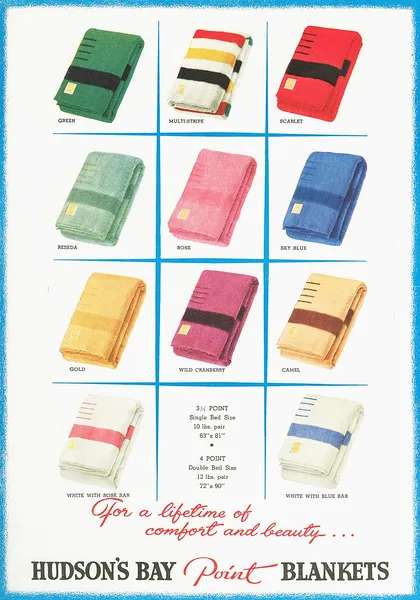
Hudson's Bay point blankets are woollen blankets originally made for the Hudson's Bay Company (HBC) in British North America, now Canada and the United States. Manufactured in England since 1779, historically they served as a form of currency during the North American fur trade exchanged with First Nations for beaver pelts. Sold by HBC trading posts, they were often hand made into winter clothing (specifically capotes and mackinaws) worn extensively by voyageurs (European fur traders) and Indigenous peoples. Beginning in the 20th century, an HBC factory-made "point blanket coat" was popularized amongst the population of Canada to the extent that it was looked on as a national dress. HBC point blankets have become part of the Canadian identity representing a nationally shared cultural symbol. The points system, marked by thin lines woven into the side of each blanket, indicates the overall size of a blanket. These lines originally allowed traders to identify blanket size at a glance. By the mid-20th century as bed sizes became standardized the point system came to indicate modern sizes, with 3.5 points denoting twin size, 4 points a double, 6 points a queen, and 8 points a king. The colour schemes of the blankets, including the multi-stripe version, historically known as "Queen Anne colours", have expanded into fashion, and lifestyle products. These "Bay 'stripe' branded products" were exclusively sold by Hudson's Bay department stores (the Bay) and affiliates until HBC intellectual property rights were purchased by Canadian Tire in 2025 during the liquidation of HBC assets. The Blanket Fund (Oshki Wupoowane), which receives 100% of the net proceeds from Hudson's Bay Point Blankets, is an Indigenous charity created to acknowledge HBC's settler colonial history and advance truth and reconciliation. The fund provides grants to "grassroots Indigenous organizations for cultural, artistic, and educational initiatives".
Also on this shelf
Bandeau.
Dalmatic.
See also
Uncatalogued shelfText from Wikipedia; plate via Wikimedia Commons. Text CC BY-SA 4.0; plate freely licensed (see Commons). Source record. Images and catalogue data are reproduced from open-access collections.