Textiles and Dress
Chutia people
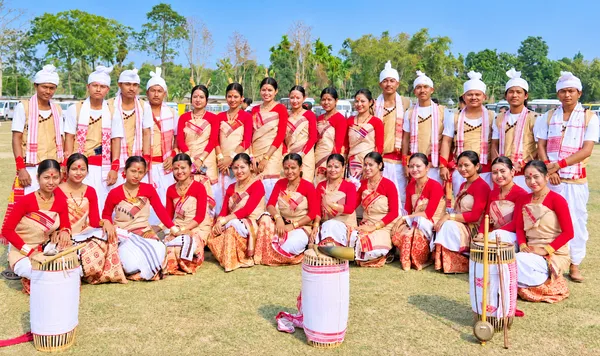
The Chutia people (Pron: or Sutia) are an ethnic group that are native to the Indian state of Assam and historically associated with the Chutia kingdom. The Chutia kingdom, with its capital at Sadiya, was a major medieval polity of Assam, whose territory extended across much of the eastern and northern Brahmaputra Valley and adjoining frontier regions before its incorporation into the Ahom kingdom in 1523–24. Following the incorporation of the kingdom, sections of the Chutia population were dispersed and resettled across other parts of Upper Assam as well as Central Assam. They constitute one of the core groups that form the Assamese people. By the early colonial period, the Chutia community had the second largest population in Upper Assam (east of Kaliabor). Today, they remain concentrated primarily in Upper Assam, while sizeable populations are also found in Darrang, Nagaon, North Guwahati (particularly Changsari and Rangmahal) and the Barak Valley. The historic Chutias originally belonged to the Bodo–Kachari group with some suspected Shan admixtures. A 2006 anthropometric study comparing six populations of Upper Assam found the Deori to be the closest comparison group to the Chutia sample, followed by the Mising and Moran. A 2004 genetic study placed the Chutias, together with the Ahoms and Rajbanshis, in an intermediate position along the historical tribe–caste continuum. The Chutias underwent processes of Sanskritisation during the period of the Chutia kingdom, followed by further cultural change under the influence of Ekasarana Dharma after the sixteenth century. They also assimilated with neighbouring populations, particularly the Ahoms. The Chutia community is recognised as an Other Backward Class by the Government of India. There has been a long-standing demand for its inclusion in the Scheduled Tribes list, and the Government of Assam has submitted a recommendation for the community's inclusion to the Government of India.
Also on this shelf
Flag of the Romani people.
Izaar.
See also
Uncatalogued shelfText from Wikipedia; plate via Wikimedia Commons. Text CC BY-SA 4.0; plate freely licensed (see Commons). Source record. Images and catalogue data are reproduced from open-access collections.