Textiles and Dress
Baju Melayu
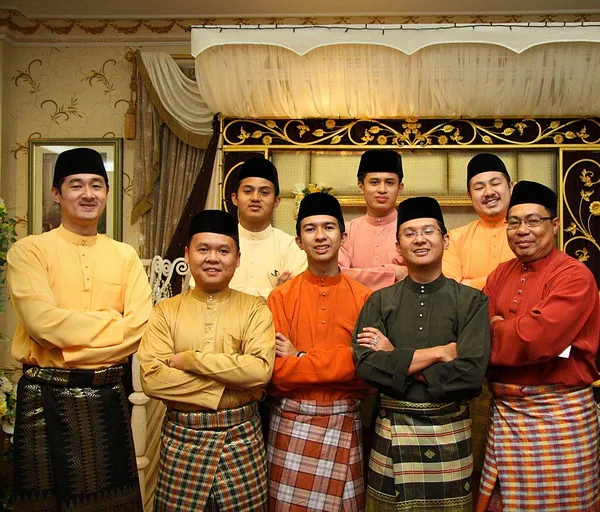
Baju Melayu (Jawi: باجو ملايو) is a traditional Malay costume worn by men in Malaysia, Brunei, Singapore, parts of Indonesia (especially Sumatra and Kalimantan), southern Philippines, and southern Thailand; originating from the court of Malacca Sultanate. In its formal form, baju Melayu is the national dress of Malaysia and Brunei, typically worn during official events and functions. A basic combination of this attire comes in two main parts. The first is the baju (long-sleeved shirt) itself which has a raised stiff collar known as the cekak musang ("fox's leash"), or the round neckline with a short slit opening down the front known as the teluk belanga; the second part is the trousers called celana or seluar. The two parts are made out of the same type of fabric which is usually cotton, or a mixture of polyester and cotton. In a formal attire, a skirt-type adornment is added, which is either the samping, made out of songket, tenun cloth or the sarong, made out of cotton or a polyester mix. The attire altogether is completed with a black or dark-colored headgear called the songkok. For a ceremonial attire (sepersalinan) commonly worn during cultural functions, the songkok ia replaced with the tengkolok. The normal baju can sometimes be substituted with a combination of tekua (a type of short sleeves jacket). In a more elaborate dress, baju sikap or baju layang (a type of coat) and pending (ornamental belt buckle) are worn. Optional accessories include a kris tucked into the samping folded at the waist, and a traditional capal (sandal).
Also on this shelf
Fibula (brooch).
East Village, Manhattan.
See also
Uncatalogued shelfText from Wikipedia; plate via Wikimedia Commons. Text CC BY-SA 4.0; plate freely licensed (see Commons). Source record. Images and catalogue data are reproduced from open-access collections.