Textiles and Dress
1550–1600 in European fashion
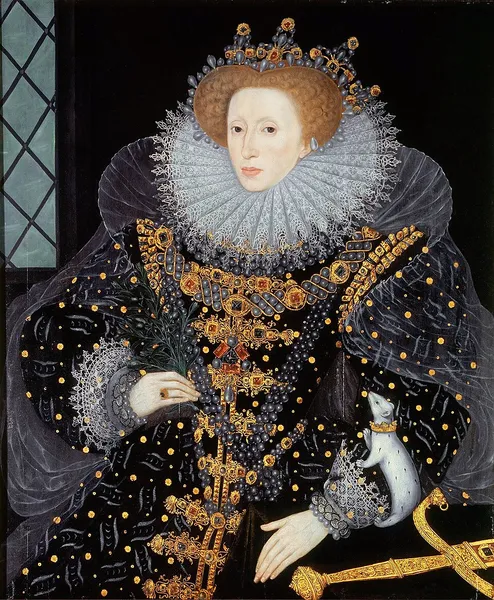
Fashion in the period 150–300 in European clothing was characterized by increased opulence. Contrasting fabrics, slashes, embroidery, applied trims, and other forms of surface ornamentation remained prominent. The wide silhouette, conical for women with breadth at the hips and broadly square for men with width at the shoulders had reached its peak in the 1530s, and by mid-century a tall, narrow line with a V-lined waist was back in fashion. Sleeves and women's skirts then began to widen again, with emphasis at the shoulder that would continue into the next century. The characteristic garment of the period was the ruff, which began as a modest ruffle attached to the neckband of a shirt or smock and grew into a separate garment of fine linen, trimmed with lace, cutwork or embroidery, and shaped into crisp, precise folds with starch and heated irons.
Also on this shelf
1300–1400 in European fashion.
Chinese Filipinos.
See also
Uncatalogued shelfText from Wikipedia; plate via Wikimedia Commons. Text CC BY-SA 4.0; plate freely licensed (see Commons). Source record. Images and catalogue data are reproduced from open-access collections.