Textiles and Dress
Francisco Goya's tapestry cartoons
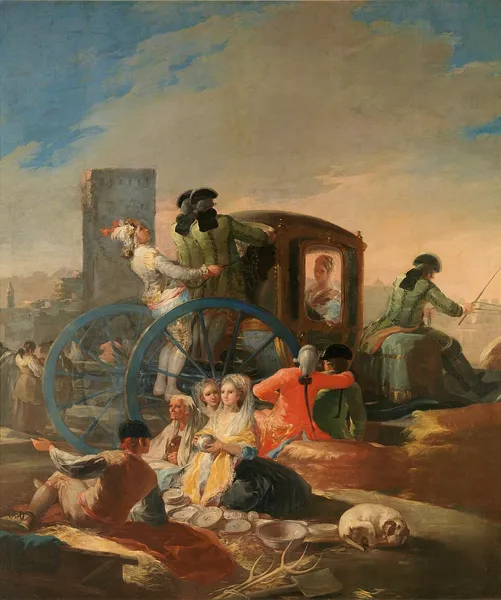
The tapestry cartoons of Francisco de Goya are a group of oil on canvas paintings by Francisco de Goya between 1775 and 1792 as designs for the Royal Tapestry Factory of Santa Barbara near Madrid in Spain. Although they are not the only tapestry cartoons made at the Royal Factory (other painters of this factory were Mariano Salvador Maella, Antonio González Velázquez, José Camarón and José del Castillo), they are much the best known. Most of them represent bucolic, hunting, rural and popular themes. They strictly adhered to the tastes of King Charles III and the princes Charles of Bourbon and Maria Luisa of Parma, and were supervised by other artists of the factory such as Maella and the Bayeu family. Most are now in the Museo del Prado, having remained in the Spanish Royal collection, although there are some in art galleries in other countries. After a fruitful career in his native Aragon, the renowned court painter Francisco Bayeu got his brother-in-law to go to Madrid to work on the decorative works for the royal palaces. By then, Anton Raphael Mengs was the most prominent artist at the court after Tiepolo's death in 1770. It was this employment at the court that most satisfied the ambition of Goya, and which would eventually make him the most fashionable artist for the wealthy class of Madrid. Between 1780 and 1786 he left this commission to spend his time as an artist in other private activities. The tapestry cartoons are structured in seven series, each with a different number of works and subject matter. A common feature in all of them is the presence of rural themes and popular entertainment. Only the first one shows themes related to hunting. Once finished, the cartoons were woven into tapestry and placed in the piece for which they were intended in the royal palaces. In 1858 they went to the basement of the Royal Palace of Madrid, where some were stolen in 1870. That year Gregorio Cruzada undertook the task of cataloging them and showing them to the public in the museum. They appeared for the first time in the official catalog of the institution in 1876. However, some small modellos (painted by Goya for the approval of the subjects) were in the hands of the Dukes of Osuna, whose descendants auctioned them in 1896.
Also on this shelf
Banyan (clothing).
Clothing sizes.
See also
Uncatalogued shelfText from Wikipedia; plate via Wikimedia Commons. Text CC BY-SA 4.0; plate freely licensed (see Commons). Source record. Images and catalogue data are reproduced from open-access collections.