Textiles and Dress
Huadian (make-up)
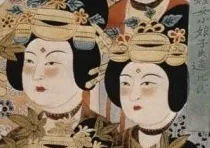
Huadian (traditional Chinese: 花鈿; simplified Chinese: 花钿), also known as huazi (Chinese: 花子; lit. 'little flower'), mianhua (Chinese: 面花), meizi (Chinese: 媚子), plum blossom makeup or plum makeup (Chinese: 梅花妝; pinyin: méihuāzhuāng or Chinese: 落梅妝; pinyin: luòméizhuāng) or shouyang makeup (Chinese: 壽陽妝), is a form of traditional Chinese women's ornamental forehead makeup, which is located between the eyebrows and sometimes on the cheeks, the temples, and the dimples. According to folklore, the huadian in floral shape originated in the Southern dynasty period; its creation is attributed to Princess Shouyang, a daughter of Emperor Wu of Liu Song (420 – 479 AD). However, the origins of huadian can be traced back earlier than these legends to the Qin and Han dynasties, and even in the pre-Qin period with its customs arising as early as the Spring and Autumn period (c. 770 – 476 BC) and Warring States period (c. 475 – 221 BC) based on archaeological artifacts and studies. Its origins has no connection with the diandan (Chinese: 点丹; lit. 'cinnabar dot'), i.e. baihao (Chinese: 白毫), found on the middle of the forehead of Buddha statues. The huadian was also popular among Tang and Song dynasty women. The popularity of huadian declined in the Yuan dynasty. Huadian is an integral part of Chinese clothing culture. In present days, huadian is often combined with the wearing of hanfu, the traditional clothing of the Han Chinese.
Also on this shelf
James Galanos.
Kariyushi shirt.
See also
Uncatalogued shelfText from Wikipedia; plate via Wikimedia Commons. Text CC BY-SA 4.0; plate freely licensed (see Commons). Source record. Images and catalogue data are reproduced from open-access collections.