Textiles and Dress
1300–1400 in European fashion
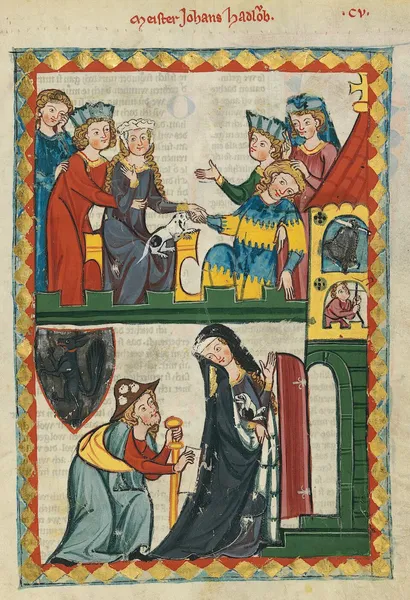
Fashion in fourteenth-century Europe was marked by the beginning of a period of experimentation with different forms of clothing. Costume historian James Laver suggests that the mid-14th century marks the emergence of recognizable "fashion" in clothing, in which Fernand Braudel concurs. The draped garments and straight seams of previous centuries were replaced by curved seams and the beginnings of tailoring, which allowed clothing to more closely fit the human form. Also, the use of lacing and buttons allowed a more snug fit to clothing. In the course of the century the length of male hemlines progressively reduced, and by the end of the century it was fashionable for men to omit the long loose over-garment of previous centuries (whether called tunic, kirtle, or other names) altogether, putting the emphasis on a tailored top that fell a little below the waist—a silhouette that is still reflected in men's costume today.
Also on this shelf
Foot fetishism.
African College of Commerce and Technology.
See also
Uncatalogued shelfText from Wikipedia; plate via Wikimedia Commons. Text CC BY-SA 4.0; plate freely licensed (see Commons). Source record. Images and catalogue data are reproduced from open-access collections.