Textiles and Dress
Blackface
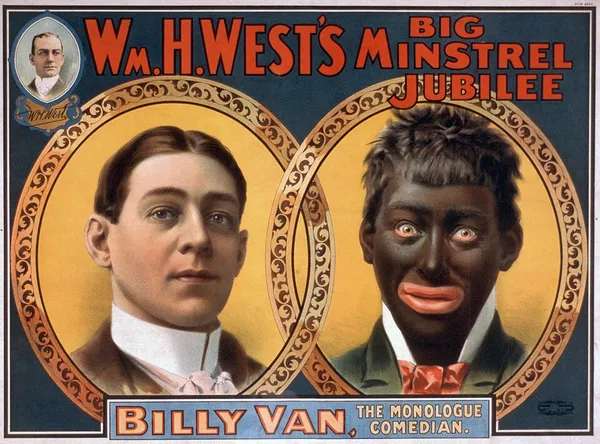
Blackface is the practice of performers of any race or ethnicity, usually white people, using burned cork, shoe polish, or theatrical makeup to portray a racialized caricature of black people, e.g. African Americans, on stage or in entertainment. It is overwhelmingly condemned as a racist and deeply inappropriate act. Scholarship on the origins or definition of blackface vary with some taking a global perspective that includes European culture and Western colonialism. Scholars with this wider view may date the practice of blackface to as early as Medieval Europe's mystery plays when bitumen and coal were used to darken the skin of white performers portraying demons, devils, and damned souls. Others date the practice to English Renaissance theater, in works such as William Shakespeare's Othello and Anne of Denmark's personal performance in The Masque of Blackness. Blackface became a global phenomenon as an outgrowth of theatrical practices of racial impersonation in theatres across the British Empire, where it was integral to the development of imperial racial politics. However, some scholars see blackface as a specific practice limited to American culture that began in the minstrel show; a performance art that originated in the United States in the early 19th century and which contained its own performance practices unique to the American stage. Scholars taking this point of view see blackface as arising not from a European stage tradition but from the context of class warfare from within the United States, with impoverished white American laborers inventing blackface as a means of expressing their anger over being disenfranchised—economically, politically, and socially—from middle and upper-class White America. In the United States, the practice of blackface became a popular entertainment during the 19th century into the 20th. It contributed to the spread of racial stereotypes such as "Jim Crow", the "happy-go-lucky darky on the plantation", and "Zip Coon" also known as the "dandified coon". By the middle of the 19th century, blackface minstrel shows had become a distinctive American artform, translating formal works such as opera into popular terms for a general audience.
Also on this shelf
Classic Lolita.
Coronation cloak.
See also
Uncatalogued shelfText from Wikipedia; plate via Wikimedia Commons. Text CC BY-SA 4.0; plate freely licensed (see Commons). Source record. Images and catalogue data are reproduced from open-access collections.