Textiles and Dress
History of Gaza
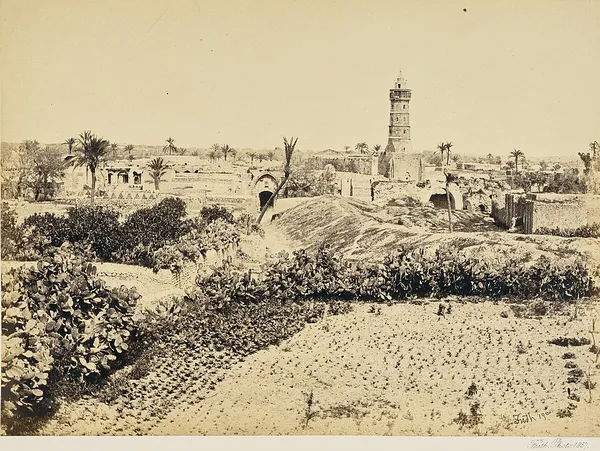
The known history of Gaza spans more than 5,000 years, and it has been ruled, destroyed and inhabited by various dynasties, empires, and peoples. Its position at the intersection of two ancient trade routes, the Via Maris and the Perfume route, meant that all manner of exotic and essential goods, as well as people, from all over the Old World passed through its port for more than three millennia. Gaza’s own people and products also moved through these trade networks. Originally an independent Canaanite cultural hub already renown in the 15th century BCE, Gaza first came under the control of the ancient Egyptians before re-emerging as an independent city kingdom, one of the pentapolis of Philistia. Gaza's king Hanunu was obliged to pay tribute to the Assyrian Empire beginning around 730 BC; however, the kingdom retained a degree of political and economic autonomy, even after being incorporated into the Achaemenid empire, and was among the first polities to mint its own coins in the Mediterranean region. Alexander the Great besieged and assaulted the city in 332 BCE, killing and capturing most of its inhabitants, and the city was resettled by its neighbouring inhabitants, becoming a center for Hellenistic learning and philosophy. The area changed hands regularly between two Greek successor-kingdoms, the Seleucids of Syria and the Ptolemies of Egypt, until it was besieged and taken by the Hasmoneans in 96 BC, shortly before their own dynasty disintegrated. Gaza was rebuilt by Roman General Pompey Magnus after 63 BCE, and allotted to the administrative territories of Roman client king Herod the Great thirty years later, but as an independent unit, and the Herodian dynasty too disintegrated, while Gaza endured. Throughout the Roman period, Gaza maintained its prosperity, receiving grants from several different emperors. A diverse, 500-member senate governed the city during this time. Conversion to Christianity in the city was spearheaded and completed under Saint Porphyrius, who destroyed its eight pagan temples between 396 and 420 AD. Gaza was conquered, along with the rest of Palestine and Syria, by general Amr ibn al-'As in 637 AD. Most of its inhabitants adopted Islam over the course of the next 1,300 years of Islamic rule, interrupted only by a century or so when Crusaders wrested control of Gaza from the Fatimids in 1100, but were driven out by Saladin.
Also on this shelf
Ainu people.
Economy of Galicia.
See also
Uncatalogued shelfText from Wikipedia; plate via Wikimedia Commons. Text CC BY-SA 4.0; plate freely licensed (see Commons). Source record. Images and catalogue data are reproduced from open-access collections.