Science and Medicine
Informed consent
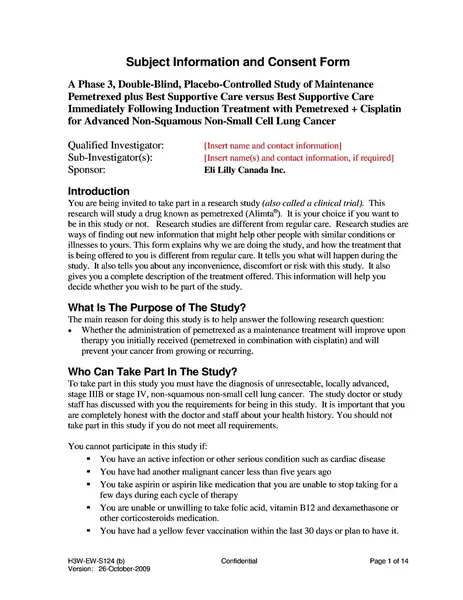
Informed consent is an applied ethics principle that a person must have sufficient information and understanding before making decisions about accepting risk. Pertinent information may include risks and benefits of treatments, alternative treatments, the patient's role in treatment, and their right to refuse treatment. In most systems, healthcare providers have a legal and ethical responsibility to ensure that a patient's consent is informed. This principle applies more broadly than healthcare intervention, for example to conduct research, to disclose a person's medical information, or to participate in high risk sporting and recreational activities. Within the United States, definitions of informed consent vary, and the standard required is generally determined by the state. As of 2016, nearly half of the states adopted a reasonable patient standard, in which the informed consent process is viewed from the patient's perspective. These standards in medical contexts are formalized in the requirement for decision-making capacity and professional determinations in these contexts have legal authority. This requirement can be summarized in brief to presently include the following conditions, all of which must be met in order for one to qualify as possessing decision-making capacity: Choice, the ability to provide or evidence a decision. Understanding, the capacity to apprehend the relevant facts pertaining to the decision at issue. Appreciation, the ability of the patient to give informed consent with concern for, and belief in, the impact the relevant facts will have upon oneself. Reasoning, the mental acuity to make the relevant inferences from, and mental manipulations of, the information appreciated and understood to apply to the decision at hand. Impairments to reasoning and judgment that may preclude informed consent include intellectual or emotional immaturity, high levels of stress such as post-traumatic stress disorder or a severe intellectual disability, severe mental disorder, intoxication, severe sleep deprivation, dementia, or coma. Obtaining informed consent is not always required.
Also on this shelf
Gonorrhea.
Bloodletting.
See also
Uncatalogued shelfText from Wikipedia; plate via Wikimedia Commons. Text CC BY-SA 4.0; plate freely licensed (see Commons). Source record. Images and catalogue data are reproduced from open-access collections.