Science and Medicine
Health in Japan
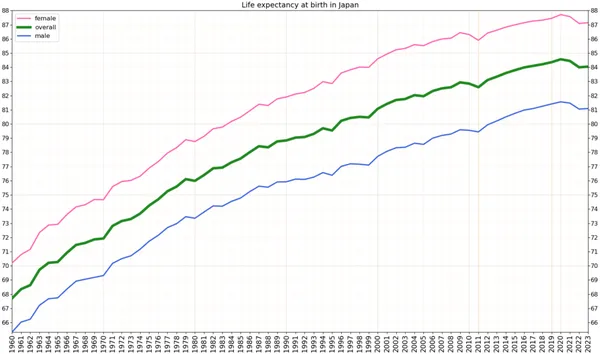
The level of health in Japan is due to a number of factors including cultural habits, isolation, and a universal health care system. John Creighton Campbell, a professor at the University of Michigan and Tokyo University, told the New York Times in 2009 that Japanese people are the healthiest group on the planet. Japanese visit a doctor nearly 14 times a year, more than four times as often as Americans. Life expectancy in 2013 was 83.3 years - among the highest on the planet. In 2018, a new measure of expected human capital was calculated for 195 countries from 1990 to 2016, and defined for each birth cohort, as the expected years lived from age 20 to 64 years and adjusted for educational attainment, learning or education quality, and functional health status. Japan had the highest level of expected human capital among the 20 largest countries: 24.1 health, education, and learning-adjusted expected years lived between age 20 and 64 years.
Also on this shelf
AIDS Walk.
2009 swine flu pandemic in the Philippines.
See also
Uncatalogued shelfText from Wikipedia; plate via Wikimedia Commons. Text CC BY-SA 4.0; plate freely licensed (see Commons). Source record. Images and catalogue data are reproduced from open-access collections.