Science and Medicine
Brain
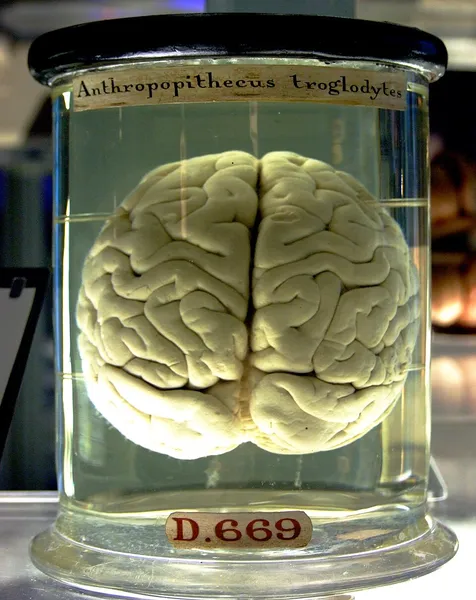
The brain is an organ that serves as the center of the nervous system in all vertebrate and most invertebrate animals. It consists of nervous tissue and is typically located in the head (cephalization), usually near organs for special senses such as vision, hearing, and olfaction. Being the most specialized organ, it is responsible for receiving information from the sensory nervous system, processing that information (thought, cognition, and intelligence) and the coordination of motor control (muscle activity) and the endocrine system. While invertebrate brains arise from paired segmental ganglia (each of which is only responsible for the respective body segment) of the ventral nerve cord, vertebrate brains develop axially from the midline dorsal nerve cord as a vesicular enlargement at the rostral end of the neural tube, with centralized control over all body segments. All vertebrate brains can be embryonically divided into three parts: the forebrain (prosencephalon, subdivided into telencephalon and diencephalon), midbrain (mesencephalon) and hindbrain (rhombencephalon, subdivided into metencephalon and myelencephalon). The spinal cord, which directly coordinates somatic functions below the head, can be considered a caudal extension of the myelencephalon enclosed inside the vertebral column. Together, the brain and spinal cord constitute the central nervous system in all vertebrates. In humans, the cerebral cortex contains approximately 14–16 billion neurons, and the estimated number of neurons in the cerebellum is 55–70 billion. Each neuron is connected by synapses to several thousand other neurons, typically communicating with one another via cytoplasmic processes known as dendrites and axons. Axons are usually myelinated and carry trains of rapid micro-electric signal pulses called action potentials to target specific recipient cells in other areas of the brain or distant parts of the body. The prefrontal cortex, which controls executive functions, is particularly well developed in humans. Physiologically, brains exert centralized control over a body's other organs. They act on the rest of the body both by generating patterns of muscle activity and by driving the secretion of chemicals called hormones. This centralized control allows rapid and coordinated responses to changes in the environment.
Also on this shelf
Endometriosis.
1834 massacre of friars in Madrid.
See also
Uncatalogued shelfText from Wikipedia; plate via Wikimedia Commons. Text CC BY-SA 4.0; plate freely licensed (see Commons). Source record. Images and catalogue data are reproduced from open-access collections.