Science and Medicine
Emerging infectious disease
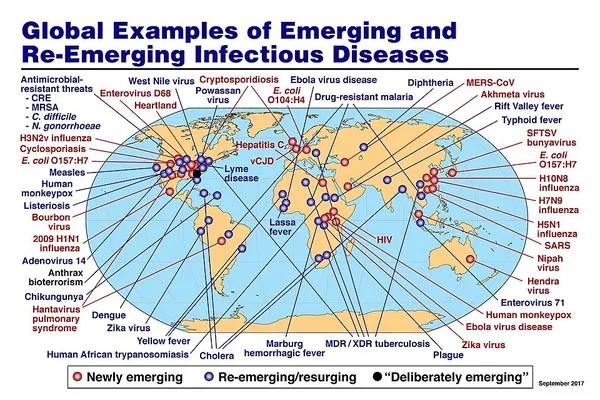
An emerging infectious disease (EID) refer to infectious diseases that have either newly appeared in a population or have existed but are rapidly increasing in incidence, geographic range, or severity due to factors such as environmental changes, antimicrobial resistance, and human-animal interactions. The minority that are capable of developing efficient transmission between humans can become major public and global concerns as potential causes of epidemics or pandemics. Their many impacts can be economic and societal, as well as clinical. EIDs have been increasing steadily since at least 1940. For every decade since 1940, there has been a consistent increase in the number of EID events from wildlife-related zoonosis. Human activity is the primary driver of this increase, with loss of biodiversity a leading mechanism. Emerging infections account for at least 12% of all human pathogens. EIDs can be caused by newly identified microbes, including novel species or strains of virus (e.g. novel coronaviruses, ebolaviruses, HIV). Some EIDs evolve from a known pathogen, as occurs with new strains of influenza. EIDs may also result from spread of an existing disease to a new population in a different geographic region, as occurs with West Nile fever outbreaks. Some known diseases can also emerge in areas undergoing ecologic transformation (as in the case of Lyme disease). Others can experience a resurgence as a re-emerging infectious disease, like tuberculosis (following drug resistance) or measles. Nosocomial (hospital-acquired) infections, such as methicillin-resistant Staphylococcus aureus are emerging in hospitals, and are extremely problematic in that they are resistant to many antibiotics. Of growing concern are adverse synergistic interactions between emerging diseases and other infectious and non-infectious conditions leading to the development of novel syndemics. Many EID are zoonotic, deriving from pathogens present in animals, with only occasional cross-species transmission into human populations. For instance, most emergent viruses are zoonotic (whereas other novel viruses may have been circulating in the species without being recognized, as occurred with hepatitis C).
Also on this shelf
Charles Horace Mayo.
Gastroenterology.
See also
Uncatalogued shelfText from Wikipedia; plate via Wikimedia Commons. Text CC BY-SA 4.0; plate freely licensed (see Commons). Source record. Images and catalogue data are reproduced from open-access collections.