Science and Medicine
Cochlear implant
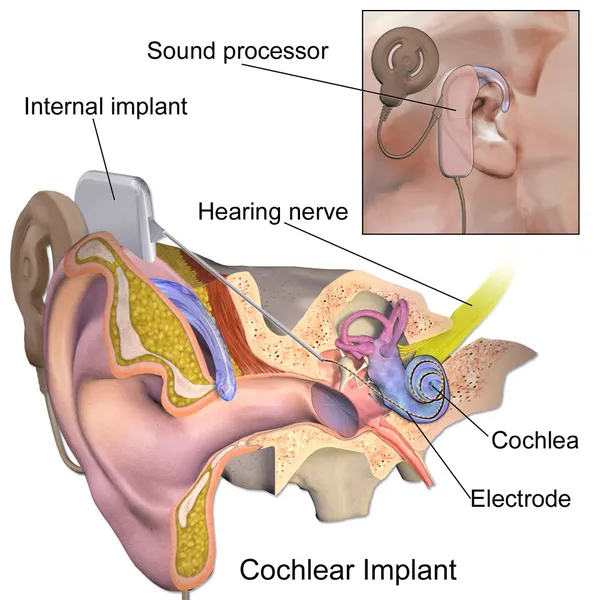
A cochlear implant (CI) is a surgically implanted neuroprosthesis that provides a person who has moderate-to-profound sensorineural hearing loss with sound perception. With the help of therapy, cochlear implants may allow for improved speech understanding in both quiet and noisy environments. A CI bypasses acoustic hearing by direct electrical stimulation of the auditory nerve. Through everyday listening and auditory training, cochlear implants allow both children and adults to learn to interpret those signals as speech and sound. The implant has two main components. The outside component is the sound processor, which contains microphones, electronics that include digital signal processor (DSP) chips, battery, and a coil that transmits a signal to the implant across the skin. It is generally worn behind the ear, though some self-contained sound processors take the form of a pebble-shaped unit worn directly on the side of the head over the implant site, held in place by magnetic attraction to the internal implant. The sound processor could also be attached to clothing, for example, in the case of young children. The inside component is the actual implant, which contains a coil to receive signals, electronics, and an array of electrodes that stimulate the cochlear nerve, which is placed into the cochlea. The surgical procedure is performed under general anesthesia. Surgical risks are minimal, and most individuals will undergo outpatient surgery and go home the same day. However, some individuals will experience dizziness, and on rare occasions, tinnitus or facial nerve bruising. From the early days of implants in the 1970s and 1980s, speech perception via an implant improved greatly, though gains have plateaued since the introduction of modern sound coding strategies in the 1990s. More than 200,000 people in the United States had received a CI through 2019. Many users of modern implants gain reasonable to good hearing and speech perception skills post-implantation, especially when combined with lipreading. One of the challenges that remain with these implants is that hearing and speech understanding skills after implantation show a wide range of variation across individual implant users.
Also on this shelf
Christianity and science.
Abu Bakr al-Razi.
See also
Uncatalogued shelfText from Wikipedia; plate via Wikimedia Commons. Text CC BY-SA 4.0; plate freely licensed (see Commons). Source record. Images and catalogue data are reproduced from open-access collections.