Science and Medicine
Eradication of malaria
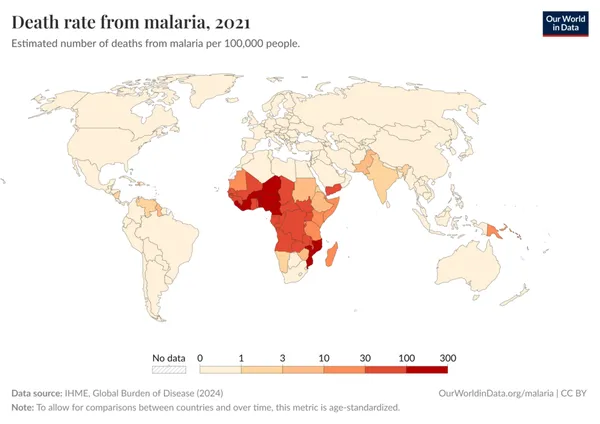
Malaria, the mosquito-borne infectious disease caused by Plasmodium parasites, has been successfully eliminated or significantly reduced in many regions of the world, but remains widespread in others. Most of Europe, North America, Australia, North Africa and the Caribbean, along with parts of South America, Asia and Southern Africa, are now free from malaria, while much of the central part of Africa continues to experience high levels of transmission. The World Health Organization (WHO) defines "elimination" (or "malaria-free") as having no domestic transmission (indigenous cases) for the past three years. They also define "pre-elimination" and "elimination" stages when a country has fewer than 5 or 1, respectively, cases per 1000 people at risk per year. In 2021, the total of international and national funding for malaria control and elimination was $3.5 billion—only half of what is estimated to be needed. According to UNICEF, to achieve the goal of a malaria-free world, annual funding would need to more than double to reach the US$6.8 billion target. In parts of the world with rising living standards, the elimination of malaria was often a collateral benefit of the introduction of window screens and improved sanitation. A variety of usually simultaneous interventions represents best practice. These include antimalarial drugs to prevent or treat infection; improvements in public health infrastructure to diagnose, sequester and treat infected individuals; bednets and other methods intended to keep mosquitoes from biting humans; and vector control strategies such as larvaciding with insecticides, ecological controls such as draining mosquito breeding grounds or introducing fish to eat larvae and indoor residual spraying (IRS) with insecticides.
Also on this shelf
Environmental issues in Appalachia.
Gunshot wound.
See also
Uncatalogued shelfText from Wikipedia; plate via Wikimedia Commons. Text CC BY-SA 4.0; plate freely licensed (see Commons). Source record. Images and catalogue data are reproduced from open-access collections.