Science and Medicine
Axon
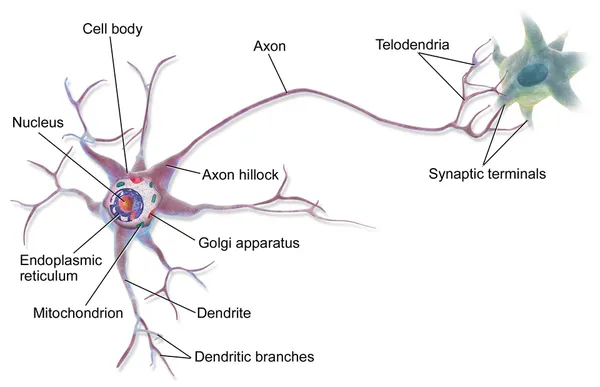
An axon (from Ancient Greek: ἄξων, romanized: áxōn, lit. 'axis'; also called a nerve fiber or fibre) is a long slender projection of a nerve cell or neuron found in most animals that typically conducts electrical impulses known as action potentials away from the nerve cell body. The function of the axon is to transmit information to different neurons, muscles, and glands. In certain sensory neurons (pseudounipolar neurons), such as those for touch and warmth, the axons are called afferent nerve fibers and the electrical impulse travels along these from the periphery to the cell body and from the cell body to the spinal cord along another branch of the same axon. Axon dysfunction can be the cause of many inherited and many acquired neurological disorders that affect both the peripheral and central neurons. Vertebrate nerve fibers are classed into three types – group A nerve fibers, group B nerve fibers, and group C nerve fibers. Groups A and B are myelinated, and group C is unmyelinated. These groups include both sensory fibers and motor fibers. Another classification groups only the sensory fibers into four categories: Type I, Type II, Type III, and Type IV. An axon is one of two types of cytoplasmic protrusions from the cell body of a neuron; the other type is a dendrite. Axons are distinguished from dendrites by several features, including shape (dendrites often taper while axons usually maintain a constant radius), length (dendrites are restricted to a small region around the cell body while axons can be much longer), and function (dendrites receive signals whereas axons transmit them). Some types of neurons have no axon and transmit signals from their dendrites. In some species, axons can emanate from dendrites known as axon-carrying dendrites. Neurons rarely have more than one axon; however, in invertebrates such as insects, decapods and leeches, the axon sometimes consists of several regions that function more or less independently of each other, and multiple axons can emerge from a single cell body in lobster cardiac ganglia. Axons are covered by a membrane known as an axolemma; the cytoplasm within an axon is called axoplasm. Most axons branch, in some cases very profusely. The end branches of an axon are called telodendria.
Also on this shelf
Egyptian temple.
AIDS Walk.
See also
Uncatalogued shelfText from Wikipedia; plate via Wikimedia Commons. Text CC BY-SA 4.0; plate freely licensed (see Commons). Source record. Images and catalogue data are reproduced from open-access collections.