Science and Medicine
2010s Haiti cholera outbreak
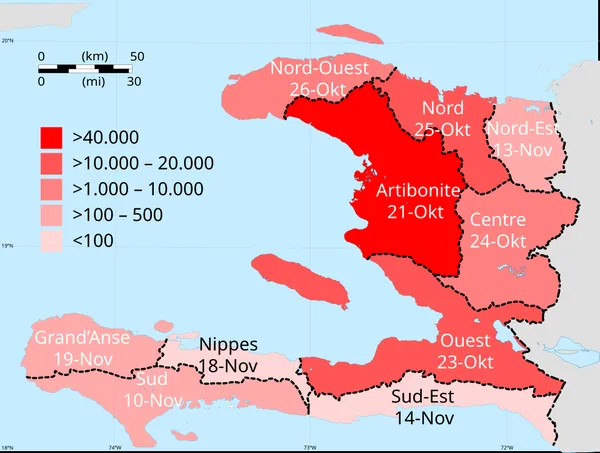
The 2010s Haiti cholera outbreak was the first modern large-scale outbreak of cholera—a disease once considered under control largely due to the invention of modern sanitation. The disease was reintroduced to Haiti in October 2010, not long after the disastrous earthquake earlier that year, and became endemic after spreading throughout the country, causing high levels of both morbidity and mortality. 820,000 Haitians were infected by cholera, and nearly 10,000 died, according to the United Nations (UN). Early efforts were made to cover up the source of the epidemic, but thanks largely to the investigations of journalist Jonathan M. Katz and epidemiologist Renaud Piarroux, it is widely believed to be the result of contamination by infected UN peacekeepers deployed from Nepal. In terms of total infections, the outbreak has since been surpassed by the 2016–2022 cholera outbreak in war-torn Yemen, although the Haiti outbreak is still one of the most deadly modern outbreaks. Following the outbreak's conclusion in February 2019, cholera transmission in Haiti largely became the subject of eradication efforts including WASH (water, sanitation, and hygiene), education, oral vaccination, and climate variability. After a three-year hiatus, new cholera cases reappeared in October 2022.
Also on this shelf
Cholera pit.
Graça Freitas.
See also
Uncatalogued shelfText from Wikipedia; plate via Wikimedia Commons. Text CC BY-SA 4.0; plate freely licensed (see Commons). Source record. Images and catalogue data are reproduced from open-access collections.