Science and Medicine
History of phagocytosis
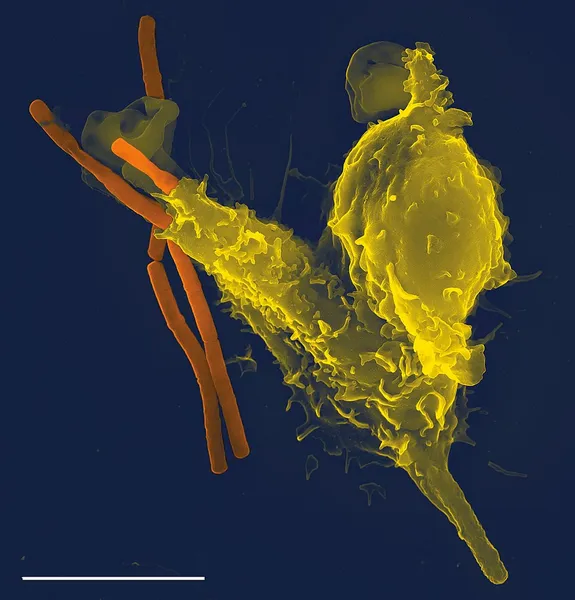
The history of phagocytosis is an account of the discoveries of cells, known as phagocytes, that are capable of eating other cells or particles, and how that eventually established the science of immunology. Phagocytosis is broadly used in two ways in different organisms, for feeding in unicellular organisms (protists) and for immune response to protect the body against infections in metazoans. Although it is found in a variety of organisms with different functions, its fundamental process is cellular ingestion of foreign (external) materials, and thus, is considered as an evolutionarily conserved process. The biological theory and concept, experimental observations, and the name, phagocyte (from Ancient Greek φαγεῖν (phagein) 'to eat' and κύτος (kytos) 'cell') were introduced by a Ukrainian zoologist Élie Metchnikoff in 1883, the moment regarded as the foundation or birth of immunology. The discovery of phagocytes and the process of innate immunity earned Metchnikoff the 1908 Nobel Prize in Physiology or Medicine, and the epithet "father of natural immunity". However, the cellular process was known before Metchnikoff's works, but with inconclusive descriptions. The first scientific description was from Albert von Kölliker who in 1849 reported an alga eating a microbe. In 1862, Ernst Haeckel experimentally showed that some blood cells in a slug could ingest external particles. By then evidences were mounting that leukocytes can perform cell eating just like protists, but it was not until Metchnikoff showed that specific leukocytes (in his case macrophages) eat cells that the role of phagocytosis in immunity was realised.
Also on this shelf
2010s Haiti cholera outbreak.
2023–2026 mpox epidemic.
See also
Uncatalogued shelfText from Wikipedia; plate via Wikimedia Commons. Text CC BY-SA 4.0; plate freely licensed (see Commons). Source record. Images and catalogue data are reproduced from open-access collections.