Science and Medicine
Evolution
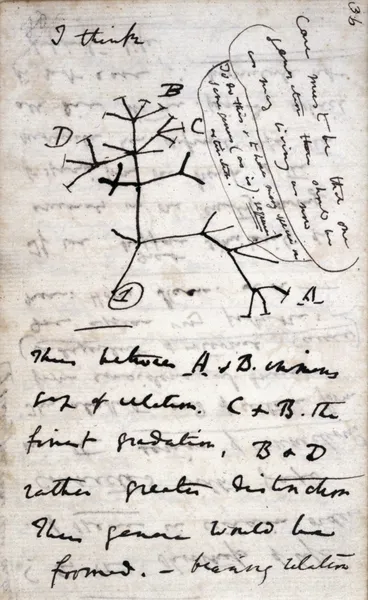
Evolution is the change in the heritable characteristics of biological populations over successive generations. It happens when individuals in a population vary in their genetic characteristics and in the numbers of their surviving offspring. Mutation introduces new genetic variation, and processes such as genetic drift, gene flow, and natural selection result in some genetic variants becoming more or less common over time. Evolution is often defined as a change in the frequency of alleles (the variants of a gene found at a specific locus) in a population. In common parlance, evolution is often understood to involve a change in an organism's external appearance or behavior (phenotype). However, because alleles do not necessarily have a visible effect, in a strict biological sense evolution can occur even when the phenotype is unchanged. The process of evolution has given rise to biodiversity at every level of biological organisation. The scientific theory of evolution by natural selection was conceived independently by two British naturalists, Charles Darwin and Alfred Russel Wallace, in the mid-19th century as an explanation for why organisms are adapted to their physical and biological environments. The theory was first set out in detail in Darwin's book On the Origin of Species. Evolution by natural selection is established by observable facts about living organisms: (1) more offspring are often produced than can possibly survive; (2) traits vary among individuals with respect to their morphology, physiology, and behaviour; (3) different traits confer different rates of survival and reproduction (differential fitness); and (4) traits can be passed from generation to generation (heritability of fitness). In successive generations, members of a population are therefore more likely to be replaced by the offspring of parents with favourable characteristics for that environment. In the early 20th century, competing ideas of evolution were refuted and evolution was combined with Mendelian inheritance and population genetics to give rise to modern evolutionary theory. In this synthesis the basis for heredity is in DNA molecules that pass information from generation to generation.
Also on this shelf
Betty Bumpers.
College health.
See also
Uncatalogued shelfText from Wikipedia; plate via Wikimedia Commons. Text CC BY-SA 4.0; plate freely licensed (see Commons). Source record. Images and catalogue data are reproduced from open-access collections.