Science and Medicine
Drug-eluting stent
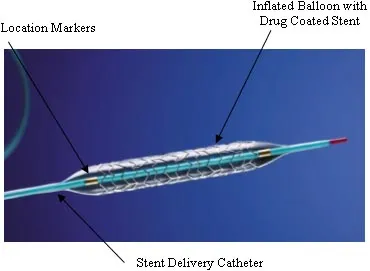
A drug-eluting stent (DES) is a medical implant consisting of a tube, made of a mesh-like material. It is used to treat atherosclerosis, the narrowing of arteries. It alleviates the symptom both mechanically (by providing a supporting scaffold inside the artery) and pharmacologically (by slowly releasing a pharmaceutical compound). A DES is inserted into a narrowed artery using a delivery catheter usually inserted through a larger artery in the groin or wrist. The stent assembly carries the DES mechanism towards the front of the catheter, and is usually composed of the collapsed stent over a collapsed polymeric balloon mechanism which is inflated to expand the stent once in position. The stent expands and embeds into the occluded artery wall, keeping the artery open, thereby improving blood flow. The mesh design allows for stent expansion and also for new healthy vessel endothelial cells to grow through and around it, securing it in place. A DES differs from other types of stents in that it keeps a blood vessel open mechanically and also delivers a small amount of a drug directly into the blood vessel wall for a limited period of time. The drug is chemically attached to the wall of the stent. After the stent has been positioned and the clogged vessel reopened, the stent delivers a small amount of the drug into the blood vessel interior wall. This delivery allows time for stent embedding and reduces the chances of the stent interior becoming blocked. Only a small amount of tissue growth inhibiting drug is carried by the stent, just enough to allow time for blood vessel embedding and for it to function mechanically to keep a vessel open. DESs are commonly used in the treatment of narrowed arteries in the heart (coronary artery disease (CAD)), but also elsewhere in the body, especially the legs (peripheral artery disease). Since coronary stenting became routine following US FDA approval in 1994, it has matured into a primary minimally invasive treatment tool in managing CAD. Coronary artery stenting is inherently tied to percutaneous coronary intervention (PCI) procedures. PCI is a minimally invasive procedure performed via a catheter (not by open-chest surgery), it is the medical procedure used to place a DES in narrowed coronary arteries.
Also on this shelf
Jane S. Richardson.
Avian influenza.
See also
Uncatalogued shelfText from Wikipedia; plate via Wikimedia Commons. Text CC BY-SA 4.0; plate freely licensed (see Commons). Source record. Images and catalogue data are reproduced from open-access collections.