Science and Medicine
Chinese giant salamander
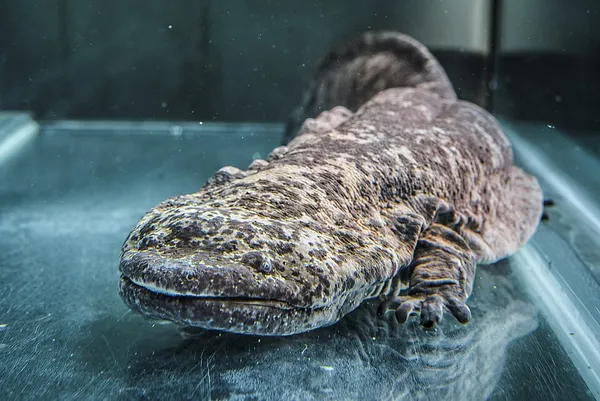
The Chinese giant salamander (Andrias davidianus) is the largest salamander and the largest amphibian in the world. It is fully aquatic, and is endemic to rocky mountain streams and lakes in the Yangtze river basin of central China. It has also been introduced to Kyoto Prefecture in Japan, and possibly to Taiwan. It is considered critically endangered in the wild due to habitat loss, pollution, and overcollection, as it is considered a delicacy and used in traditional Chinese medicine. On farms in central China, it is extensively farmed and sometimes bred, although many of the salamanders on the farms are caught in the wild. It has been listed as one of the top-10 "focal species" in 2008 by the Evolutionarily Distinct and Globally Endangered project. The Chinese giant salamander is considered to be a "living fossil". Although protected under Chinese law and CITES Appendix I, the wild population has declined by more than an estimated 80% since the 1950s. Although traditionally recognized as one of two living species of Andrias salamander in Asia, the other being the Japanese giant salamander, evidence indicates that the Chinese giant salamander may be composed of at least five cryptic species, further compounding each individual species' endangerment.
Also on this shelf
History of writing.
Bayt Mal Al Qods Acharif Agency.
See also
- ▸African swine fever virus
- ▸Canadian Indian residential school gravesites
- ▸Age of consent in the United States
Text from Wikipedia; plate via Wikimedia Commons. Text CC BY-SA 4.0; plate freely licensed (see Commons). Source record. Images and catalogue data are reproduced from open-access collections.