Science and Medicine
Crocodile
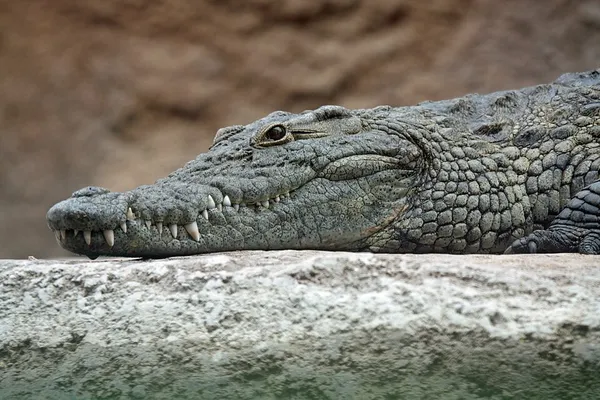
A crocodile (family Crocodylidae) or true crocodile is a large, semiaquatic reptile that lives throughout the tropics in Africa, Asia, the Americas and Australia. The term "crocodile" is sometimes used more loosely to include all extant members of the order Crocodilia, which includes the alligators and caimans (both members of the family Alligatoridae), the gharial and false gharial (both members of the family Gavialidae) as well as other extinct taxa. This article uses "crocodile" or "true crocodile" to refer only to the species taxonomically included in the Crocodylidae family, extant or extinct. Crocodile size, morphology, behaviour and ecology differ among species. However, they have many similarities in these areas as well. All crocodiles are semiaquatic and tend to congregate in freshwater habitats such as rivers, lakes, wetlands and sometimes in brackish water and saltwater. They are carnivorous animals, feeding mostly on vertebrates such as fish, reptiles, birds and mammals, and sometimes on invertebrates such as molluscs and crustaceans, depending on species and age. All crocodiles are tropical species that, unlike alligators, are very sensitive to cold. Many species are at the risk of extinction, some being classified as critically endangered.
Also on this shelf
Kharkiv National Medical University.
Gideon Mantell.
See also
Uncatalogued shelfText from Wikipedia; plate via Wikimedia Commons. Text CC BY-SA 4.0; plate freely licensed (see Commons). Source record. Images and catalogue data are reproduced from open-access collections.