Science and Medicine
Colonial Origins of Comparative Development
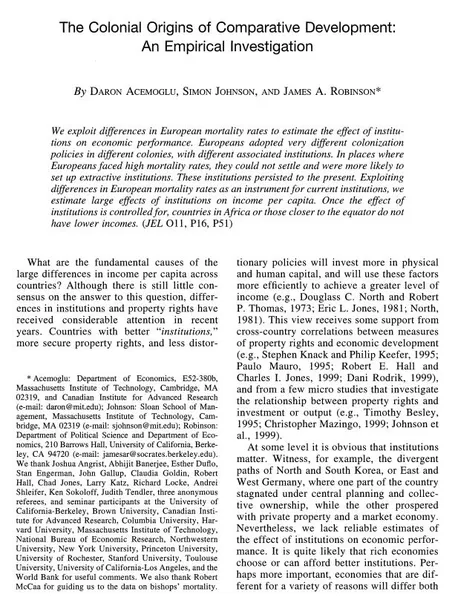
"The Colonial Origins of Comparative Development" is a 2001 article written by Daron Acemoglu, Simon Johnson, and James A. Robinson and published in American Economic Review. It is considered a seminal contribution to development economics through its use of European settler mortality as an instrumental variable of institutional development in former colonies. The theory proposed in the article is that Europeans only set up growth-inducing institutions in areas where the disease environment was favourable so that they could settle. In areas with unfavourable disease environments to Europeans, such as central Africa, they instead set up extractive institutions which persist to the present day and explain much of the variation in income across countries. Other theories explored in the article argue that it is the choices of institutions within the country that result in the effective and efficient use of resources in leading to the successful development of that country. Important issues with the data and analysis have been identified, causing some doubt as to the accuracy of these results. The trio of authors have won the 2024 Nobel Memorial Prize in Economic Sciences.
Also on this shelf
Kristine Gebbie.
Austin Flint II.
See also
Uncatalogued shelfText from Wikipedia; plate via Wikimedia Commons. Text CC BY-SA 4.0; plate freely licensed (see Commons). Source record. Images and catalogue data are reproduced from open-access collections.