Science and Medicine
African-American family structure
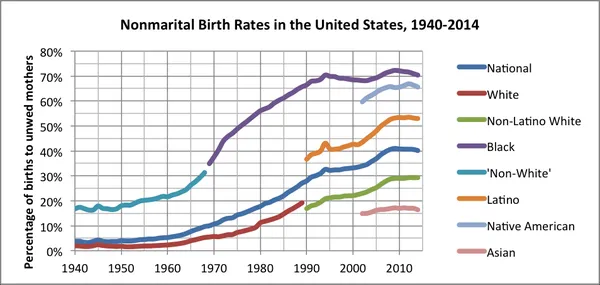
Family structure refers to the composition of a family, including present members and important figures from the past, as well as the quality of relationships among them. It can be visualized using a genogram to depict the family's structure, composition, and relationships. A nuclear family consists of a pair of adults and their sociologically recognized biological chlldren. The initial involuntary migration of African Americans to the United States caused an ad hoc family structure, based on enslaved people who lived in proximity to one another, and changing as people were sold, died prematurely or disconnected in some other manner. This created more emphasis on the extended family and non-biological connectedness of people as opposed to formalized titles and relationships. The continued need for extended non-biological "family" continued throughout Reconstruction and Jim Crow because of the prevalence at which nuclear families were disrupted because of premature death, primarily of fathers, grandfathers and other male figureheads. There are exceptions to this, as evidenced by the detailed genealogical detail documented by the Blackwell Family of Virginia, an African-American family that traces its roots back to a woman who arrived in Virginia in 1735. Many notable African American figures throughout history have grown up in single-parent homes due to their fathers being killed. Examples include Malcolm X, whose father Earl Little died while tied to rail tracks, and Emmett Till, whose father Louis Till was lynched while serving in the United States Army. This helped to normalize within the culture to not blame or ostracize the woman for being a single mother, which had a significant impact on the acceptability of out of wedlock childbirth. The family structure of African Americans has long been a matter of national public policy interest. A 1965 report by Daniel Patrick Moynihan, known as The Moynihan Report, examined the link between black poverty and family structure. It hypothesized that the destruction of the black nuclear family structure would hinder further progress toward economic and political equality. When Moynihan wrote in 1965 on the coming destruction of the black family, the out-of-wedlock birth rate was 25% among black people.
Also on this shelf
Crowdsourcing.
Brincidofovir.
See also
Uncatalogued shelfText from Wikipedia; plate via Wikimedia Commons. Text CC BY-SA 4.0; plate freely licensed (see Commons). Source record. Images and catalogue data are reproduced from open-access collections.