Science and Medicine
James A. Garfield
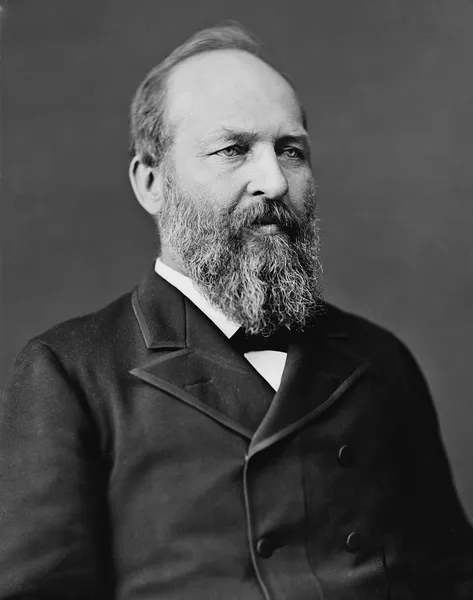
James Abram Garfield (November 19, 1831 – September 19, 1881) was the 20th president of the United States, serving from March 1881 until his death in September that year after being shot in July. A preacher, lawyer, and Civil War general, Garfield served nine terms in the United States House of Representatives and is the only sitting member of the House to be elected president. Before he ran for president, the Ohio General Assembly had elected him to the U.S. Senate, a position he declined upon becoming president-elect. Garfield was born into poverty in a log cabin and grew up in northeast Ohio. After graduating from Williams College in 1856, he studied law and became an attorney. Garfield was a preacher in the Restoration Movement and president of the Western Reserve Eclectic Institute, affiliated with the Disciples. He was elected as a Republican member of the Ohio State Senate in 1859, serving until 1861. Garfield opposed Confederate secession, was a major general in the Union Army during the American Civil War, and fought in the battles of Middle Creek, Shiloh, and Chickamauga. He was elected to Congress in 1862 to represent Ohio's 19th district. Throughout his congressional service, Garfield firmly supported the gold standard and gained a reputation as a skilled orator. He initially agreed with Radical Republican views on Reconstruction but later favored a Moderate Republican–aligned approach to civil rights enforcement for freedmen. Garfield's aptitude for mathematics extended to his own proof of the Pythagorean theorem, published in 1876, and his advocacy of using statistics to inform government policy. At the 1880 Republican National Convention, delegates chose Garfield, who had not sought the White House, as a compromise presidential nominee on the 36th ballot. In the 1880 presidential election, he conducted a low-key front porch campaign and narrowly defeated the Democratic nominee, Winfield Scott Hancock. Garfield's accomplishments as president included his assertion of presidential authority against senatorial courtesy in executive appointments, a purge of corruption in the Post Office, and his appointment of a Supreme Court justice. He advocated for agricultural technology, an educated electorate, and civil rights for African Americans.
Also on this shelf
Flattening the curve.
Angelo Maffucci.
See also
Uncatalogued shelfText from Wikipedia; plate via Wikimedia Commons. Text CC BY-SA 4.0; plate freely licensed (see Commons). Source record. Images and catalogue data are reproduced from open-access collections.